

Latest [Jan 05, 2022] Realistic Verified AZ-104 Dumps
Pass Microsoft AZ-104 Exam Updated 465 Questions
Module 1: The Management of Azure Governance and Identities
This section covers the hybrid identity of the Azure. Professionals should learn about how to set up the Active AD Join in a given situation, create groups and users as well as manage their properties, perform the interpretation of the access assignments, and more. After completing the learning track of this module, learners will be able to handle end-to-end management of Azure AD objects along with the RBAC. Notable importance has also been given to Azure subscription management and governance.
NEW QUESTION 138
You have an Azure subscription named Subscription1 that contains the resources in the following table.
VM1 and VM2 run the websites in the following table.
AppGW1 has the backend pools in the following table.
DNS resolves site1.contoso.com, site2.contoso.com, and site3.contoso.com to the IP address of AppGW1.
AppGW1 has the listeners in the following table.
AppGW1 has the rules in the following table.
For each of the following statements, select Yes if the statement is true. Otherwise, select No.
NOTE: Each correct selection is worth one point.
Answer:
Explanation:
NEW QUESTION 139
You have an Azure subscription that contains an Azure file share.
You have an on-premises server named Server1 that runs Windows Server 2016.
You plan to set up Azure File Sync between Server1 and the Azure file share.
You need to prepare the subscription for the planned Azure File Sync.
Which two actions should you perform in the Azure subscription? To answer, drag the appropriate actions to the correct targets. Each action may be used once, more than once, or not at all. You may need to drag the split bar between panes or scroll to view content.
Answer:
Explanation:
Explanation
As per the official MS doc:
The recommended steps to onboard on Azure File Sync for the first with zero downtime while preserving full file fidelity and access control list (ACL) are as follows:
1. Deploy a Storage Sync Service. --> This needs to be done on Azure .
2. Create a sync group. --> This needs to be done on Azure
3. Install Azure File Sync agent on the server with the full data set. --> This needs to be done on server1.
4. Register that server and create a server endpoint on the share. --> This needs to be done on server1.
5. Let sync do the full upload to the Azure file share (cloud endpoint).
6. After the initial upload is complete, install Azure File Sync agent on each of the remaining servers.
7. Create new file shares on each of the remaining servers.
8. Create server endpoints on new file shares with cloud tiering policy, if desired. (This step requires additional storage to be available for the initial setup.)
9. Let Azure File Sync agent do a rapid restore of the full namespace without the actual data transfer. After the full namespace sync, sync engine will fill the local disk space based on the cloud tiering policy for the server endpoint.
10. Ensure sync completes and test your topology as desired.
11. Redirect users and applications to this new share.
12. You can optionally delete any duplicate shares on the servers.
First action: Create a Storage Sync Service
The deployment of Azure File Sync starts with placing a Storage Sync Service resource into a resource group of your selected subscription.
Second action: Create a sync group
A sync group defines the sync topology for a set of files. Endpoints within a sync group are kept in sync with each other. A sync group must contain one cloud endpoint, which represents an Azure file share and one or more server endpoints. A server endpoint represents a path on a registered server. A server can have server endpoints in multiple sync groups. You can create as many sync groups as you need to appropriately describe your desired sync topology.
Third action: Run Server Registration
Registering your Windows Server with a Storage Sync Service establishes a trust relationship between your server (or cluster) and the Storage Sync Service. A server can only be registered to one Storage Sync Service and can sync with other servers and Azure file shares associated with the same Storage Sync Service. ) Reference:
https://docs.microsoft.com/en-us/azure/storage/files/storage-sync-files-deployment-guide?tabs=azure-portal
NEW QUESTION 140
You have Azure subscription that includes following Azure file shares:
You have the following on-premises servers:
You create a Storage Sync Service named Sync1 and an Azure File Sync group named Group1. Group1 uses share1 as a cloud endpoint.
You register Server1 and Server2 in Sync1. You add D:\Folder1 on Server1 as a server endpoint of Group1.
For each of the following statements, select Yes if the statement is true. Otherwise, select No.
NOTE: Each correct selection is worth one point.
Answer:
Explanation:
Explanation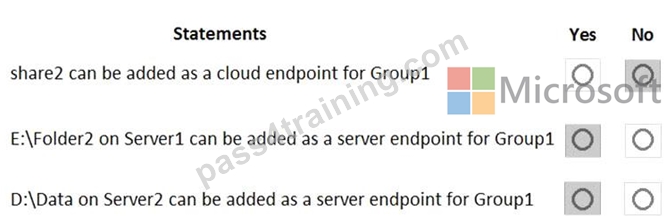
Box 1: No
Group1 already has a cloud endpoint named Share1.
A sync group must contain one cloud endpoint, which represents an Azure file share and one or more server endpoints.
Box 2: Yes
Yes, one or more server endpoints can be added to the sync group.
Box 3: Yes
Yes, one or more server endpoints can be added to the sync group.
References:
https://docs.microsoft.com/en-us/azure/storage/files/storage-sync-files-deployment-guide
NEW QUESTION 141
You purchase a new Azure subscription named Subscription1.
You create a virtual machine named VM1 in Subscription1. VM1 is not protected by Azure Backup.
You need to protect VM1 by using Azure Backup. Backups must be created at 01:00 and stored for 30 days.
What should you do? To answer, select the appropriate options in the answer area.
NOTE: Each correct selection is worth one point.
Answer:
Explanation:
References:
https://docs.microsoft.com/en-us/azure/backup/backup-azure-recovery-services-vault-overview https://docs.microsoft.com/en-us/azure/backup/backup-azure-vms-first-look-arm
https://docs.microsoft.com/en-us/azure/backup/backup-azure-recovery-services-vault-overview https://docs.microsoft.com/en-us/azure/backup/backup-azure-vms-first-look-arm
NEW QUESTION 142
You have an Azure Migrate project that has the following assessment properties:
* Target location: East US
* Storage redundancy: Locally redundant
* Comfort factor: 2.0
* Performance history: 1 month
* Percentile utilization: 95th
* Pricing tier: Standard
* Offer: Pay as you go
You discover the following two virtual machines:
* A virtual machine named VM1 that runs Windows Server 2016 and has 10 CPU cores at 20 percent utilization
* A virtual machine named VM2 that runs Windows Server 2012 and has four CPU cores at 50 percent utilization How many CPU cores will Azure Migrate recommend for each virtual machine? To answer, select the appropriate options in the answer area.
NOTE: Each correct selection is worth one point.
Answer:
Explanation:
Explanation
The equation is: 'core usage x comfort factor'. The comfort factor is 2.0.
So VM 1 is 10 cores at 20% utilization which equals 2 cores. Multiply that the comfort factor and you get 4 cores.
VM 2 is 4 cores at 50% utilization which equals 2 cores. Multiply that the comfort factor and you get 4 cores.
NEW QUESTION 143
You have an Azure subscription that contains an Azure Directory (Azure AD) tenant named contoso.com. The tenant is synced to the on-premises Active Directory domain. The domain contains the users shown in the following table.
You enable self-service password reset (SSPR) for all users and configure SSPR to have the following authentication methods:
Number of methods required to reset: 2
Methods available to users: Mobile phone, Security questions
Number of questions required to register: 3
Number of questions required to reset: 3
You select the following security questions:
What is your favorite food?
In what city was your first job?
What was the name of your first pet?
For each of the following statements, select Yes if the statement is true. Otherwise, select No.
NOTE: Each correct selection is worth one point.
Answer:
Explanation:
Explanation:
Box 1: No
Administrator accounts are special accounts with elevated permissions. To secure them, the following restrictions apply to changing passwords of administrators:
On-premises enterprise administrators or domain administrators cannot reset their password through Self-service password reset (SSPR). They can only change their password in their on-premises environment. Thus, we recommend not syncing on-prem AD admin accounts to Azure AD.
An administrator cannot use secret Questions & Answers as a method to reset password.
Box 2: Yes
Self-service password reset (SSPR) is an Azure Active Directory feature that enables employees to reset their passwords without needing to contact IT staff.
Box 3: Yes
References:
https://docs.microsoft.com/en-us/azure/active-directory/authentication/howto-sspr-deployment
NEW QUESTION 144
You are evaluating the name resolution for the virtual machines after the planned implementation of the Azure networking infrastructure.
For each of the following statements, select Yes if the statement is true. Otherwise, select No.
Answer:
Explanation:
NEW QUESTION 145
You create a virtual machine scale set named Scale1. Scale1 is configured as shown in the following exhibit.
Use the drop-down menus to select the answer choice that completes each statement based on the information presented in the graphic.
Answer:
Explanation:
Explanation
As cooling period and scale in and scale out durations are not displayed in the graphical view, so we need to consider the default values as below for these settings.
Cool down (minutes) : The amount of time to wait before the rule is applied again so that the autoscale actions have time to take effect. Default is 5 minutes.
Duration : The amount of time monitored before the metric and threshold values are compared. Default is 10 minutes.
Box 1: 4 virtual machines
The Autoscale scale out rule increases the number of VMs by 2 if the CPU threshold is 80% or higher for more than or equals to 10 mins due to default duration for scale in and out is 10 minutes. Since CPU utilization at 85% only lasts for 6 mins , it does not trigger the rules.
Hence no of virtual machines will be same as the initial value which is 4.
Box 2: 4 virtual machines
The Autoscale scale in rule decreases the number of VMs by 4 if the CPU threshold is 30% or lower for more than or equal to 10 mins. due to default duration for scale in and out is 10 minutes . Since CPU utilization at
30% only lasts for 6 mins , it does not trigger the rules. Hence after first 6 mins instance count will be same as initial count as 4. After that CPU utilization reached to 50% for 6 mins , which again would not trigger the scale in rule. Therefore no of virtual machines will be same as the initial value which is 4.
References:
https://docs.microsoft.com/en-us/azure/azure-monitor/platform/autoscale-overview
https://docs.microsoft.com/en-us/azure/azure-monitor/platform/autoscale-best-practices
https://docs.microsoft.com/en-us/azure/azure-monitor/platform/autoscale-common-scale-patterns
NEW QUESTION 146
You have an Azure subscription named Subscription1 that contains the resources shown in the following table.
In storage1, you create a blob container named blob1 and a file share named share1.
Which resources can be backed up to Vault1 and Vault2? To answer, select the appropriate options in the answer area.
NOTE: Each correct selection is worth one point.
Answer:
Explanation:
Explanation:
Box 1: VM1 only
VM1 is in the same region as Vault1.
File1 is not in the same region as Vautl1.
SQL is not in the same region as Vault1.
Blobs cannot be backup up to service vaults.
Note: To create a vault to protect virtual machines, the vault must be in the same region as the virtual machines.
Box 2: Share1 only.
Storage1 is in the same region (West USA) as Vault2. Share1 is in Storage1.
Note: After you select Backup, the Backup pane opens and prompts you to select a storage account from a list of discovered supported storage accounts. They're either associated with this vault or present in the same region as the vault, but not yet associated to any Recovery Services vault.
References:
https://docs.microsoft.com/bs-cyrl-ba/azure/backup/backup-create-rs-vault
https://docs.microsoft.com/en-us/azure/backup/backup-afs
NEW QUESTION 147
You have an Azure subscription that contains a virtual machine scale set. The scale set contains four instances that have the following configurations:
* Operating system: Windows Server 2016
* Size: Standard_D1_v2
You run the get-azvmss cmdlet as shown in the following exhibit:
Use the drop-down menus to select the answer choice that completes each statement based on the information presented in the graphic.
NOTE: Each correct selection is worth one point.
Answer:
Explanation:
Explanation:
The Get-AzVmssVM cmdlet gets the model view and instance view of a Virtual Machine Scale Set (VMSS) virtual machine.
Box 1: 0
The enableAutomaticUpdates parameter is set to false. To update existing VMs, you must do a manual upgrade of each existing VM.
Box 2: 4
Enabling automatic OS image upgrades on your scale set helps ease update management by safely and automatically upgrading the OS disk for all instances in the scale set.
Reference:
https://docs.microsoft.com/en-us/azure/virtual-machine-scale-sets/virtual-machine-scale-sets-upgrade-scale-set
https://docs.microsoft.com/en-us/azure/virtual-machine-scale-sets/virtual-machine-scale-sets-automatic-upgrade
NEW QUESTION 148
You have an Azure subscription named Subscription1. Subscription1 contains the resources in the following table.
In Azure, you create a private DNS zone named adatum.com. You set the registration virtual network to VNet2. The adatum.com zone is configured as shown in the following exhibit.
For each of the following statements, select Yes if the statement is true. Otherwise, select No.
NOTE: Each correct selection is worth one point.
Answer:
Explanation:
Explanation
Box 1: No
Azure DNS provides automatic registration of virtual machines from a single virtual network that's linked to a private zone as a registration virtual network. VM5 does not belong to the registration virtual network though.
Box 2: No
Forward DNS resolution is supported across virtual networks that are linked to the private zone as resolution virtual networks. VM5 does belong to a resolution virtual network.
Box 3: Yes
VM6 belongs to registration virtual network, and an A (Host) record exists for VM9 in the DNS zone.
By default, registration virtual networks also act as resolution virtual networks, in the sense that DNS resolution against the zone works from any of the virtual machines within the registration virtual network.
References: https://docs.microsoft.com/en-us/azure/dns/private-dns-overview
NEW QUESTION 149
You have an Azure subscription named Subscription1.
You deploy a Linux virtual machine named VM1 to Subscription1.
You need to monitor the metrics and the logs of VM1.
What should you use?
- A. the AzurePerformanceDiagnostics extension
- B. Azure HDInsight
- C. Linux Diagnostic Extension (LAD) 3.0
- D. Azure Analysis Services
Answer: A
Explanation:
Section: [none]
Explanation:
You can use extensions to configure diagnostics on your VMs to collect additional metric data.
The basic host metrics are available, but to see more granular and VM-specific metrics, you need to install the Azure diagnostics extension on the VM. The Azure diagnostics extension allows additional monitoring and diagnostics data to be retrieved from the VM.
Reference:
https://docs.microsoft.com/en-us/azure/virtual-machines/linux/tutorial-monitoring
NEW QUESTION 150
You have two Azure virtual machines named VM1 and VM2. VM1 has a single data disk named Disk1. You need to attach Disk1 to VM2. The solution must minimize downtime for both virtual machines.
Which four actions should you perform in sequence? To answer, move the appropriate actions from the list of actions to the answer area and arrange them in the correct order.
Answer:
Explanation:
Step 1: Stop VM1.
Step 2: Detach Disk1 from VM1.
Step 3: Start VM1.
Detach a data disk using the portal
* In the left menu, select Virtual Machines.
* Select the virtual machine that has the data disk you want to detach and click Stop to deallocate the VM.
* In the virtual machine pane, select Disks.
* At the top of the Disks pane, select Edit.
* In the Disks pane, to the far right of the data disk that you would like to detach, click the Detach button image detach button.
* After the disk has been removed, click Save on the top of the pane.
* In the virtual machine pane, click Overview and then click the Start button at the top of the pane to restart the VM.
* The disk stays in storage but is no longer attached to a virtual machine.
Step 4: Attach Disk1 to VM2
Attach an existing disk
Follow these steps to reattach an existing available data disk to a running VM.
* Select a running VM for which you want to reattach a data disk.
* From the menu on the left, select Disks.
* Select Attach existing to attach an available data disk to the VM.
* From the Attach existing disk pane, select OK.
References:
https://docs.microsoft.com/en-us/azure/virtual-machines/windows/detach-disk
https://docs.microsoft.com/en-us/azure/lab-services/devtest-lab-attach-detach-data-disk
NEW QUESTION 151
You have an Azure subscription named Subcription1 that contains a resource group named RG1.
In RG1. you create an internal load balancer named LB1 and a public load balancer named 162.
You need to ensure that an administrator named Admin 1 can manage LB1 and LB2. The solution must follow the principle of least privilege.
Which role should you assign to Admin1 for each task? To answer, select the appropriate options in the answer area.
NOTE: Caen correct selection is worth one point.
Answer:
Explanation:
Explanation
Box 1: Network Contributor on RG1
To add to the backend pool, write permission is required on the Resource Group because it writes deployment information. To add a backend pool, you need network contributor role on the LB and on the VMs that will be part of the backend pool.
For this reason the network contributor role must be assigned to the RG where the LB and the VM resides. So the correct answer is Network Contributor on RG1 .
Box 2: Network Contributor on RG1
For Health Probe also, without having access to RG1, no health probe can be added. If only Network Contributor role is assigned to LB then the user would not be able to access the IP addresses of the member pools.
Owner/Contributor can give the user access for everything. So it will not fit into the the principle of least privilege. Hence Owner and contributor role is incorrect choices for the question.
Reference:
https://docs.microsoft.com/en-us/azure/role-based-access-control/built-in-roles
NEW QUESTION 152
You have an Azure subscription that contains the public load balancers shown in the following table.
You plan to create six virtual machines and to load balancer requests to the virtual machines. Each load balancer will load balance three virtual machines.
You need to create the virtual machines for the planned solution.
How should you create the virtual machines? To answer, select the appropriate options in the answer area.
NOTE: Each correct selection is worth one point.
Answer:
Explanation:
Explanation
Box 1: be created in the same availability set or virtual machine scale set.
The Basic tier is quite restrictive. A load balancer is restricted to a single availability set, virtual machine scale set, or a single machine.
Box 2: be connected to the same virtual network
The Standard tier can span any virtual machine in a single virtual network, including blends of scale sets, availability sets, and machines.
References:
https://www.petri.com/comparing-basic-standard-azure-load-balancers
NEW QUESTION 153
You have an Azure subscription that contains a resource group named RG26.
RG26 is sot to the West Europe location and is used to create temporary resources for a project. RG26 contains the resources shown in the following table.
SQLD01 is backed up to RGV1.
When the project is complete, you attempt to delete RG26 from the Azure portal. The deletion fails.
You need to delete RG26.
What should you do first?
- A. Delete VM1.
- B. Delete sa001.
- C. Stop the backup of SQLDB01.
- D. StopVM1.
Answer: C
Explanation:
You can't delete a vault that contains backup data. So in this case at first you have to delete the backup of 'SQLD01' before you attempt to delete the vault.
Reference:
https://docs.microsoft.com/en-us/azure/backup/backup-azure-delete-vault
NEW QUESTION 154
You have an Azure subscription that contains the following storage account:
You need 10 create a request to Microsoft Support to perform a live migration of storage1 to Zone Redundant Storage (ZRS) replication. How should you modify storage1 before the Live migration?
- A. Disable Advanced threat protection
- B. Remove the lock
- C. Set the replication to Locally-redundant storage (IRS)
- D. Set the access tier to Hot
Answer: C
NEW QUESTION 155
......
AZ-104:Microsoft Azure Administrator Exam Certified Professional salary
The average salary of a AZ-104:Microsoft Azure Administrator Exam Certified Expert in
- India - 12,10,327 INR
- Europe - 60,547 EURO
- United State - 80,000 USD
- England - 60,532 POUND
Get 2022 Updated Free Microsoft AZ-104 Exam Questions & Answer: https://examsboost.pass4training.com/AZ-104-test-questions.html
