

Free AZ-104 braindumps download (AZ-104 exam dumps Free Updated Mar 12, 2026)
AZ-104 Dumps for Pass Guaranteed - Pass AZ-104 Exam 2026
NEW QUESTION # 161
You have several Azure virtual machines on a virtual network named VNet1.
You configure an Azure Storage account as shown in the following exhibit.
Use the drop-down menus to select the answer choice that completes each statement based on the information presented in the graphic.
NOTE: Each correct selection is worth one point.
Answer:
Explanation:
Explanation:
Box 1: always
Endpoint status is enabled.
Box 2: Never
After you configure firewall and virtual network settings for your storage account, select Allow trusted Microsoft services to access this storage account as an exception to enable Azure Backup service to access the network restricted storage account.
Reference:
https://docs.microsoft.com/en-us/azure/storage/files/storage-how-to-use-files-windows
https://azure.microsoft.com/en-us/blog/azure-backup-now-supports-storage-accounts-secured-with-azure-storage-firewalls-and-virtual-networks/
NEW QUESTION # 162
You plan to create a new Azure Active Directory (Azure AD) role.
You need to ensure that the new role can view all the resources in the Azure subscription and issue support requests to Microsoft. The solution must use the principle of least privilege.
How should you complete the JSON definition? To answer, select the appropriate options in the answer area.
NOTE: Each correct selection is worth one point.
Answer:
Explanation: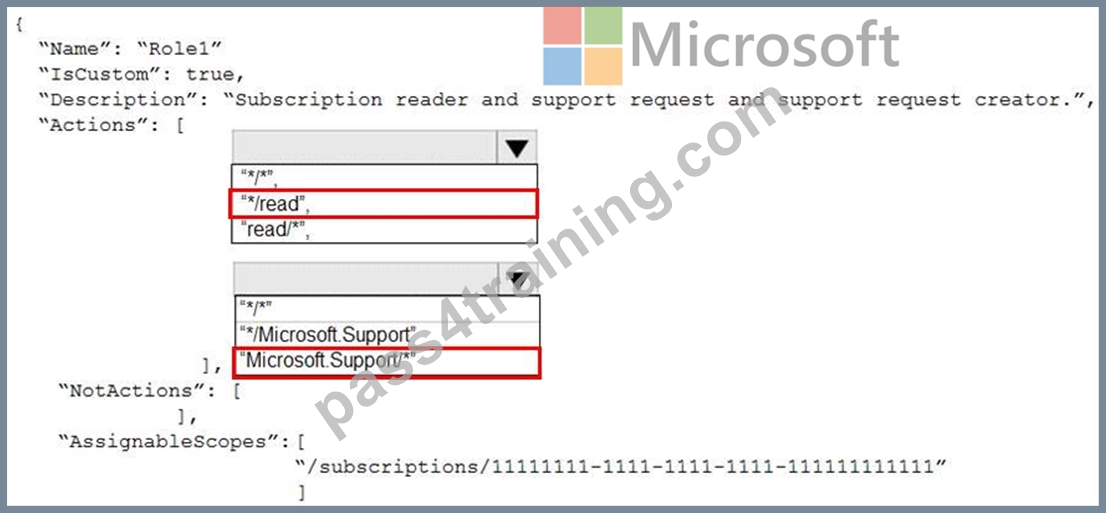
Explanation:
Box 1: "*/read",
*/read lets you view everything, but not make any changes.
Box 2: " Microsoft.Support/*"
The action Microsoft.Support/* enables creating and management of support tickets.
References:
https://docs.microsoft.com/en-us/azure/role-based-access-control/tutorial-custom-role-powershell
https://docs.microsoft.com/en-us/azure/role-based-access-control/built-in-roles
NEW QUESTION # 163
You have a registered DNS domain named contoso.com.
You create a public Azure DNS zone named contoso.com.
You need to ensure that records created in the contoso.com zone are resolvable from the internet.
What should you do?
- A. Modify the SOA record in the DNS domain registrar.
- B. Create the SOA record in contoso.com.
- C. Create NS records in contoso.com.
- D. Modify the NS records in the DNS domain registrar.
Answer: D
Explanation:
Reference:
https://docs.microsoft.com/en-us/azure/dns/dns-delegate-domain-azure-dns
NEW QUESTION # 164
You have Azure subscriptions named Subscription1 and Subscription2.
Subscription1 has following resource groups:
RG1 includes a web app named App1 in the West Europe location.
Subscription2 contains the following resource groups:
For each of the following statements, select Yes if the statement is true. Otherwise, select No.
NOTE: Each correct selection is worth one point.
Answer:
Explanation:
Explanation:
App1 present in RG1 and in RG1 there is no lock available. So you can move App1 to other resource groups, RG2, RG3, RG4.
Note:
App Service resources can only be moved from the resource group in which they were originally created. If an App Service resource is no longer in its original resource group, move it back to its original resource group.
Reference:
https://docs.microsoft.com/en-us/azure/azure-resource-manager/management/move-limitations/app-service- move-limitations
NEW QUESTION # 165
You have an Azure subscription named Subscription1. Subscription1 contains two Azure virtual machines named VM1 and VM2. VM1 and VM2 run Windows Server 2016.
VM1 is backed up daily by Azure Backup without using the Azure Backup agent.
VM1 is affected by ransomware that encrypts data.
You need to restore the latest backup of VM1.
To which location can you restore the backup? To answer, select the appropriate options in the answer area.
NOTE: Each correct selection is worth one point.
Answer:
Explanation:
Reference:
https://docs.microsoft.com/en-us/azure/backup/backup-azure-arm-restore-vms
https://docs.microsoft.com/en-us/azure/backup/backup-azure-restore-files-from-vm#system-requirements
NEW QUESTION # 166
You have an Azure Service Bus.
You create a queue named Queue1. Queue1 is configured as shown in the following exhibit.
Use the drop-down menus to select the answer choice that completes each statement based on the information presented in the graphic.
NOTE: Each correct selection is worth one point.
Answer:
Explanation:
Reference:
https://docs.microsoft.com/en-us/azure/service-bus-messaging/message-expiration
https://docs.microsoft.com/en-us/azure/service-bus-messaging/message-transfers-locks-settlement
NEW QUESTION # 167
Note: This question is part of a series of questions that present the same scenario. Each question in the series contains a unique solution that might meet the stated goals. Some question sets might have more than one correct solution, while others might not have a correct solution.
After you answer a question in this section, you will NOT be able to return to it. As a result, these questions will not appear in the review screen.
You have an Azure subscription that contains 10 virtual networks. The virtual networks are hosted in separate resource groups.
Another administrator plans to create several network security groups (NSGs) in the subscription.
You need to ensure that when an NSG is created, it automatically blocks TCP port 8080 between the virtual networks.
Solution: From the Resource providers blade, you unregister the Microsoft.ClassicNetwork provider.
Does this meet the goal?
- A. No
- B. Yes
Answer: A
Explanation:
No, this does not meet the goal. Unregistering the Microsoft.ClassicNetwork provider does not affect the creation of network security groups (NSGs) in the subscription. The Microsoft.ClassicNetwork provider is used for managing classic deployment model resources, such as virtual networks, network interfaces, and public IP addresses1. However, NSGs are only supported for Resource Manager deployment model resources2. Therefore, unregistering the Microsoft.ClassicNetwork provider will not automatically block TCP port 8080 between the virtual networks.
To meet the goal, you need to create a custom policy definition that enforces a default security rule for NSGs. A policy definition is a set of rules and actions that Azure performs when evaluating your resources3. You can use a policy definition to specify the required properties and values for NSGs, such as the direction, protocol, source, destination, and port of the security rule. You can then assign the policy definition to the subscription scope, so that it applies to all the resource groups and virtual networks in the subscription.
NEW QUESTION # 168
You have an Azure subscription named Sub1 that contains the Azure resources shown in the following table.
You assign an Azure policy that has the following settings:
* Scope: Sub1
* Exclusions: Sub1/RG1/VNET1
* Policy definition: Append a tag and its value to resources
* Policy enforcement: Enabled
* Tag name: Tag4
* Tag value: value4
You assign tags to the resources as shown in the following table.
For each of the following statements, select Yes if the statement is true. Otherwise, select No.
NOTE: Each correct selection is worth one point.
Answer:
Explanation:
* RG1 has the Tag2: IT tag assigned only. No, this is not correct. According to the tables, RG1 has two tags assigned: Tag2: IT and Tag3: value2. The Azure policy does not affect RG1, because it is excluded from the scope of the policy. Therefore, RG1 does not have the Tag4: value4 tag appended by the policy.
* Storage1 has the Tag1: subscription, Tag2: IT, Tag3: value1, and Tag4: value4 tags assigned. Yes, this is correct. According to the tables, Storage1 has three tags assigned: Tag1: subscription, Tag2: IT, and Tag3: value1. The Azure policy affects Storage1, because it is within the scope of the policy and not excluded. Therefore, Storage1 has the Tag4: value4 tag appended by the policy.
* VNET1 has the Tag2: IT and Tag3: value2 tags assigned only. Yes, this is correct. According to the tables, VNET1 has two tags assigned: Tag2: IT and Tag3: value2. The Azure policy does not affect VNET1, because it is excluded from the scope of the policy. Therefore, VNET1 does not have the Tag4: value4 tag appended by the policy.
NEW QUESTION # 169
You need to prepare the environment to ensure that the web administrators can deploy the web apps as quickly as possible.
Which three actions should you perform in sequence? To answer, move the appropriate actions from the list of actions to the answer area and arrange them in the correct order.
Answer:
Explanation:
Explanation:
Scenario:
1. Web administrators will deploy Azure web apps for the marketing department.
2. Each web app will be added to a separate resource group.
3. The initial configuration of the web apps will be identical.
4. The web administrators have permission to deploy web apps to resource groups.
Steps:
1 --> Create a resource group, and then deploy a web app to the resource group.
2 --> From the Automation script blade of the resource group , click Add to Library.
3 --> From the Templates service, select the template, and then share the template to the web administrators .
References:
https://docs.microsoft.com/en-us/azure/azure-resource-manager/templates/quickstart-create-templates-use-the- portal
NEW QUESTION # 170
You have two Azure virtual machines named VM1 and VM2. VM1 has a single data disk named Disk1. You need to attach Disk1 to VM2. The solution must minimize downtime for both virtual machines.
Which four actions should you perform in sequence? To answer, move the appropriate actions from the list of actions to the answer area and arrange them in the correct order.
Answer:
Explanation:
Explanation:
Step 1: Stop VM1.
Step 2: Detach Disk1 from VM1.
Step 3: Start VM1.
Detach a data disk using the portal
In the left menu, select Virtual Machines.
Select the virtual machine that has the data disk you want to detach and click Stop to deallocate the VM.
In the virtual machine pane, select Disks.
At the top of the Disks pane, select Edit.
In the Disks pane, to the far right of the data disk that you would like to detach, click the Detach button image detach button.
After the disk has been removed, click Save on the top of the pane.
In the virtual machine pane, click Overview and then click the Start button at the top of the pane to restart the VM.
The disk stays in storage but is no longer attached to a virtual machine.
Step 4: Attach Disk1 to VM2
Attach an existing disk
Follow these steps to reattach an existing available data disk to a running VM.
Select a running VM for which you want to reattach a data disk.
From the menu on the left, select Disks.
Select Attach existing to attach an available data disk to the VM.
From the Attach existing disk pane, select OK.
References:
https://docs.microsoft.com/en-us/azure/virtual-machines/windows/detach-disk
https://docs.microsoft.com/en-us/azure/lab-services/devtest-lab-attach-detach-data-disk
NEW QUESTION # 171
You have an Azure subscription that contains a storage account named storage1.
You need to configure a shared access signature (SAS) to ensure that users can only download blobs securely by name.
Which two settings should you configure? To answer, select the appropriate settings in the answer area.
NOTE: Each correct answer is worth one point.
Answer:
Explanation:
NEW QUESTION # 172
You have an Azure subscription that contains an Azure Directory (Azure AD) tenant named contoso.com. The tenant is synced to the on-premises Active Directory domain. The domain contains the users shown in the following table.
You enable self-service password reset (SSPR) for all users and configure SSPR to have the following authentication methods:
* Number of methods required to reset: 2
* Methods available to users: Mobile phone, Security questions
* Number of questions required to register: 3
* Number of questions required to reset: 3
You select the following security questions:
* What is your favorite food?
* In what city was your first job?
* What was the name of your first pet?
For each of the following statements, select Yes if the statement is true. Otherwise, select No.
NOTE: Each correct selection is worth one point.
Answer:
Explanation:
Explanation
Box 1: No
Administrator accounts are special accounts with elevated permissions. To secure them, the following restrictions apply to changing passwords of administrators:
On-premises enterprise administrators or domain administrators cannot reset their password through Self-service password reset (SSPR). They can only change their password in their on-premises environment.
Thus, we recommend not syncing on-prem AD admin accounts to Azure AD.
An administrator cannot use secret Questions & Answers as a method to reset password.
Box 2: Yes
Self-service password reset (SSPR) is an Azure Active Directory feature that enables employees to reset their passwords without needing to contact IT staff.
Box 3: Yes
References:
https://docs.microsoft.com/en-us/azure/active-directory/authentication/howto-sspr-deployment
NEW QUESTION # 173
You have an Azure subscription that contains the resources shown in the following table.
You plan to create a data collection rule named DCRI in Azure Monitor.
Which resources can you set as data sources in DCRI, and which resources can you set as destinations in DCRI? To answer, select the appropriate options in the answer area.
NOTE: Each correct selection is worth one point.
Answer:
Explanation:
Explanation:
Data Sources: VM1 only
Destination: Workspace1 Only
NEW QUESTION # 174
You have an Azure subscription named Subscription1 that contains two Azure virtual networks named VNet1 and VNet2. VNet1 contains a VPN gateway named VPNGW1 that uses static routing. There is a site-to-site VPN connection between your on-premises network and VNet1.
On a computer named Client1 that runs Windows10, you configure a point-to-site VPN connection to VNet1.
You configure virtual network peering between VNet1 and VNet2. You verify that you can connect to VNet2 from the on-premises network. Client1 is unable to connect to VNet2.
You need to ensure that you can connect Client1 to VNet2.
What should you do?
- A. Enable BGP on VPNGW1.
- B. Download and re-install the VPN client configuration package on Client1.
- C. Select Allow gateway transit on VNet2.
- D. Select Allow gateway transit on VNet1.
Answer: B
Explanation:
https://docs.microsoft.com/en-us/azure/vpn-gateway/vpn-gateway-about-point-to-site-routing
NEW QUESTION # 175
You have an Azure virtual machine that runs Windows Server 2019 and has the following configurations:
Name: VM1
Location: West US
Connected to: VNET1
Private IP address: 10.1.0.4
Public IP addresses: 52.186.85.63
DNS suffix in Windows Server: Adatum.com
You create the Azure DNS zones shown in the following table.
You need to identify which DNS zones you can link to VNET1 and the DNS zones to which VM1 can automatically register.
Which zones should you identify? To answer, select the appropriate options in the answer area.
NOTE: Each correct selection is worth one point.
Answer:
Explanation:
Reference:
https://docs.microsoft.com/en-us/azure/dns/private-dns-overview
NEW QUESTION # 176
You are evaluating the name resolution for the virtual machines after the planned implementation of the Azure networking infrastructure.
For each of the following statements, select Yes if the statement is true. Otherwise, select No.
Answer:
Explanation:
Reference:
https://docs.microsoft.com/en-us/azure/dns/private-dns-overview
https://docs.microsoft.com/en-us/azure/virtual-network/virtual-networks-name-resolution-for-vms-and-role-instances
NEW QUESTION # 177
You have an availability set named AS1 that contains three virtual machines named VM1, VM2, and VM3.
You attempt to reconfigure VM1 to use a larger size. The operation fails and you receive an allocation failure message.
You need to ensure that the resize operation succeeds.
Which three actions should you perform in sequence? To answer, move the appropriate actions from the list of actions to the answer area and arrange them in the correct order.
Answer:
Explanation:
1 - Stop VM1, VM2 and VM3
2 - Resize VM1
3 - Start VM1, VM2, and VM3
References:
https://azure.microsoft.com/es-es/blog/resize-virtual-machines/
NEW QUESTION # 178
Note: This question is part of a series of questions that present the same scenario. Each question in the series contains a unique solution that might meet the stated goals. Some question sets might have more than one correct solution, while others might not have a correct solution.
After you answer a question in this section, you will NOT be able to return to it. As a result, these questions will not appear in the review screen.
You have an Azure Directory (Azure AD) tenant named Adatum and an Azure Subscription named Subscription1. Adatum contains a group named Developers. Subscription1 contains a resource group named Dev.
You need to provide the Developers group with the ability to create Azure logic apps in the Dev resource group.
Solution: On Dev, you assign the Contributor role to the Developers group.
Does this meet the goal?
- A. No
- B. Yes
Answer: B
Explanation:
Section: [none]
Explanation:
The Contributor role can manage all resources (and add resources) in a Resource Group.
NEW QUESTION # 179
You have an Azure virtual machine named VM1 and a Recovery Services vault named Vault1.
You create a backup Policy1 as shown in the exhibit. (Click the Exhibit tab.)
You configure the backup of VM1 to use Policy1 on Thursday, January 1.
You need to identify the number of available recovery points for VM1.
How many recovery points are available on January 8 and on January 15? To answer, select the appropriate options in the answer area.
NOTE: Each correct selection is worth one point.
Answer:
Explanation:
NEW QUESTION # 180
You have an Azure subscription that contains the resources in the following table.
You install the Web Server server role (IIS) on VM1 and VM2, and then and VM1 and VM2 to LB1.
LB1 is configured as shown in the LB1 exhibit. (Click the LB1 tab.)
Rule1 is configure as shown in the Rule1 exhibit. (Click the Rule tab.) For each of the following statements, select Yes if the statements is true. Otherwise, select No.
NOTE: Each correct selection is worth one point.
Answer:
Explanation:
Reference:
https://docs.microsoft.com/en-us/azure/load-balancer/skus
https://docs.microsoft.com/en-us/azure/load-balancer/load-balancer-custom-probe-overview
NEW QUESTION # 181
You plan to move services from your on-premises network to Azure.
You identify several virtual machines that you believe can be hosted in Azure. The virtual machines are shown in the following table.
Which two virtual machines can you access by using Azure migrate? Each correct answer presents a complete solution.
NOTE: Each correct selection is worth one point.
- A. BOS-DB01
- B. Hou-NW01
- C. Sea-CA0l
- D. NYC-FS01
- E. Sea-DC01
Answer: A,D
Explanation:
Azure Migrate provides a centralized hub to assess and migrate to Azure on-premises servers, infrastructure, applications, and data. It provides the following:
Unified migration platform: A single portal to start, run, and track your migration to Azure.
Range of tools: A range of tools for assessment and migration. Azure Migrate tools include Server Assessment and Azure Migrate: Server Migration. Azure Migrate also integrates with other Azure services and tools, and with independent software vendor (ISV) offerings.
Assessment and migration: In the Azure Migrate hub, you can assess and migrate:
Servers: Assess on-premises servers and migrate them to Azure virtual machines or Azure VMware Solution (AVS) (Preview).
Databases: Assess on-premises databases and migrate them to Azure SQL Database or to SQL Managed Instance.
Web applications: Assess on-premises web applications and migrate them to Azure App Service by using the Azure App Service Migration Assistant.
Virtual desktops: Assess your on-premises virtual desktop infrastructure (VDI) and migrate it to Windows Virtual Desktop in Azure.
Data: Migrate large amounts of data to Azure quickly and cost-effectively using Azure Data Box products.
Based on this information let's analyze each option:
NYC-FS01 : Its role "Server" fall under above categories. Hence it can be accessed by using Azure migrate.
BOS-DB01 : Its role "server" fall under above categories. Hence it can be accessed by using Azure migrate.
Sea-CA01 : Its role "CA" does not fall under above categories. Hence it can not be accessed by using Azure migrate.
Hou-NW01 : Its role "DNS" does not fall under above categories. Hence it can not be accessed by using Azure migrate.
Sea-DC01 : Its role "DC" does not fall under above categories. Hence it can not be accessed by using Azure migrate.
Reference:
https://docs.microsoft.com/en-us/azure/migrate/migrate-services-overview
NEW QUESTION # 182
You have an Azure subscription named Subscroption1.
In Subscription1, you create an alert rule named Alert1.
The Alert1 action group is configured as shown in the following exhibit.
Alert1 alert criteria is triggered every minute.
Use the drop-down menus to select the answer choice that completes each statement based on the information presented in the graphic.
NOTE: Each correct selection is worth one point.
Answer:
Explanation:
Explanation
Box 1: 60
One alert per minute will trigger one email per minute.
Box 2: 12
No more than 1 SMS every 5 minutes can be send, which equals 12 per hour.
Note: Rate limiting is a suspension of notifications that occurs when too many are sent to a particular phone number, email address or device. Rate limiting ensures that alerts are manageable and actionable.
The rate limit thresholds are:
SMS: No more than 1 SMS every 5 minutes.
Voice: No more than 1 Voice call every 5 minutes.
Email: No more than 100 emails in an hour.
Other actions are not rate limited.
References:
https://github.com/MicrosoftDocs/azure-docs/blob/master/articles/monitoring-and-diagnostics/monitoring-overv
NEW QUESTION # 183
......
In Conclusion
Moving from an entry to an associate level of expertise with the help of AZ-104 exam might be an enjoyable and exciting journey if you use the best study materials. In this case, you will pass the test easily and will get ready for any challenges in the workplace. And then, with the Microsoft Certified: Azure Administrator Associate, so many new doors will open for you!
Microsoft AZ-104 exam, also known as the Microsoft Azure Administrator exam, is designed to test an individual's knowledge and skills in managing and monitoring Microsoft Azure services. AZ-104 exam is intended for individuals who are responsible for implementing, managing, and monitoring Azure resources and services.
Verified AZ-104 dumps Q&As - Pass Guarantee Exam Dumps Test Engine: https://examsboost.pass4training.com/AZ-104-test-questions.html
