

Start your FSCP Exam Questions Preparation with Updated 82 Questions
A Fully Updated 2026 FSCP Exam Dumps - PDF Questions and Testing Engine
Forescout FSCP Exam Syllabus Topics:
| Topic | Details |
|---|---|
| Topic 1 |
|
| Topic 2 |
|
| Topic 3 |
|
| Topic 4 |
|
| Topic 5 |
|
| Topic 6 |
|
| Topic 7 |
|
| Topic 8 |
|
NEW QUESTION # 45
When configuring a Send Email action to notify CounterACT administrators, how do you add endpoint specific host information to the message?
- A. It is not possible to add specific host information for detected endpoints.
- B. Edit the Options > General > Mail settings and click "Tag" to add the desired property values.
- C. Edit the "Message to Email Recipient" Field of the Send Email action Parameters tab, then click 'Tag" to add the desired keyword tag.
- D. Create criteria in sub-rules to detect the desired specific host information. The "Send Email" action will send this information to the CounterACT administrator.
- E. Edit the "Message to Email Recipient" Field of the Send Email action Parameters tab, then click 'Tag" to add the desired property value.
Answer: E
Explanation:
Comprehensive and Detailed Explanation From Exact Extract of Forescout Platform Administration and Deployment:
According to the Forescout Administration Guide - Send Email action documentation, to add endpoint- specific host information to a Send Email notification, you should "Edit the 'Message to Email Recipient' Field of the Send Email action Parameters tab, then click 'Tag' to add the desired property value".
Property Tags in Send Email Action:
According to the Property Tags documentation:
"Property tags insert endpoint values into condition or action fields, and are replaced by the actual endpoint property value when the field is evaluated." Property tags allow dynamic insertion of endpoint-specific data into email messages.
How to Add Property Tags to Email:
According to the documentation:
* Edit Send Email Action - Open the Send Email action configuration
* Navigate to Parameters Tab - Select the Parameters tab
* Edit Message Field - Edit the "Message to Email Recipient" field
* Click Tag Button - Select the "Tag" button/option
* Choose Property - Select the endpoint property to insert (e.g., IP address, OS, etc.)
* Confirm - The property tag is inserted into the message
Example Email Message with Property Tags:
According to the More Action Tools documentation:
text
Example message:
"Endpoint [IP.Address] with hostname [IP.Hostname]
has failed compliance check for operating system [OS]."
When evaluated:
"Endpoint 192.168.1.50 with hostname WORKPC-01
has failed compliance check for operating system Windows 10."
Available Properties for Tags:
According to the documentation:
Property tags can reference:
* IP Address
* MAC Address
* Hostname
* Operating System
* Device Function
* User information
* Custom endpoint properties
Why Other Options Are Incorrect:
* A. Create criteria in sub-rules - Sub-rules don't send email; they're for conditional logic
* C. Edit Options > General > Mail settings - This is for global email configuration, not message customization
* D. It is not possible - Incorrect; property tags specifically enable this functionality
* E. "Keyword tag" - The feature uses "property tags" or "tags," not "keyword tags" Referenced Documentation:
* Send Email action
* Property Tags
* More Action Tools - Property tags section
NEW QUESTION # 46
What information must be known prior to generating a Certificate Signing Request (CSR)?
- A. IP address, CA, Host Name
- B. Hostname, IP Address, and FQDN
- C. CA, Domain Name, Administrators Name
- D. Revocation Authority, Certificate Extension, CA
- E. Certificate extension, format requirements, Encryption Type
Answer: B
Explanation:
Comprehensive and Detailed Explanation From Exact Extract of Forescout Platform Administration and Deployment:
According to the Forescout RADIUS Plugin Configuration Guide and CSR Generation documentation, the information that must be known prior to generating a Certificate Signing Request (CSR) is Hostname, IP Address, and FQDN.
Information Required for CSR Generation:
According to the RADIUS Plugin Configuration Guide:
"When you generate the certificate signing request (CSR), you must know the following information about the system requesting the certificate:
* The hostname of the system
* The IP address of the system
* The FQDN (Fully Qualified Domain Name) of the system"
Standard CSR Requirements:
According to the official documentation:
When generating a CSR, the following information is typically requested:
* Common Name (CN) - The FQDN or hostname of the system
* IP Address - The IP address of the appliance or device
* Organization Name - The organization/company name
* Organization Unit (OU) - Department or division
* Locality (L) - City or town
* State (ST) - State or province
* Country (C) - Country code
* Key Type - Typically RSA (2048-bit minimum)
Core Required Elements:
The most critical information that MUST be known before generating the CSR:
* Hostname - The computer/appliance name (e.g., "counteract-em-01")
* IP Address - The management IP address of the appliance (e.g., "192.168.1.50")
* FQDN - The fully qualified domain name (e.g., "counteract-em-01.example.com") These three pieces of information are essential because:
* The certificate's validity is tied to these identifiers
* The CSR encodes these values
* The CA uses this information to validate the certificate request
* Endpoints and systems verify certificates against these values
Why Other Options Are Incorrect:
* A. Certificate extension, format requirements, Encryption Type - These are configuration options, not prerequisite knowledge; extension type (e.g., .pfx, .pem) is determined after CSR signing
* C. IP address, CA, Host Name - Missing FQDN; while CA information is needed eventually, it's not required to GENERATE the CSR
* D. Revocation Authority, Certificate Extension, CA - Revocation authority and certificate extension are post-generation concerns; not needed to generate CSR
* E. CA, Domain Name, Administrators Name - Administrator name is not necessary for CSR generation; CA information is needed for obtaining signed certificate, not generating CSR CSR Generation Process:
According to the documentation:
* Gather Required Information - Collect hostname, IP address, and FQDN
* Generate CSR - Use tools like fstool cert gen to create the CSR file
* Answer Prompts - Provide the hostname, IP, and FQDN when prompted
* Submit to CA - Send the CSR file to a Certificate Authority for signing
* Receive Signed Certificate - CA returns the signed certificate
CSR File Output:
According to the documentation:
The CSR generation process creates a file (typically ca_request.csr) containing:
* The encoded hostname, IP address, and FQDN
* The public key
* The signature algorithm
* Other system identification information
This file is then submitted to a Certificate Authority for signing.
Referenced Documentation:
* Forescout RADIUS Plugin Configuration Guide v4.3 - Certificate Readiness section
* Create a Certificate Sign Request documentation
* How to Create a CSR (Certificate Signing Request) - DigiCert Reference
* RADIUS Plugin Configuration - System Certificate section
NEW QUESTION # 47
Select the action that requires symmetrical traffic.
- A. WLAN block
- B. Endpoint ACL
- C. Start SecureConnector
- D. Virtual Firewall
- E. Assign to VLAN
Answer: B
Explanation:
Comprehensive and Detailed Explanation From Exact Extract of Forescout Platform Administration and Deployment:
According to the Forescout Administration Guide and Switch Plugin documentation, the action that requires symmetrical traffic is the Endpoint Address ACL action (C).
What "Symmetrical Traffic" Means:
Symmetrical traffic refers to network traffic where CounterACT can monitor BOTH directions of communication:
* Inbound - Traffic from the endpoint
* Outbound - Traffic to the endpoint
This allows CounterACT to see the complete conversation flow.
Endpoint Address ACL Requirements:
According to the Switch Plugin documentation:
"The Endpoint Address ACL action applies an ACL that delivers blocking protection when endpoints connect to the network. Other benefits of Endpoint Address ACL include..." For the Endpoint Address ACL to function properly, CounterACT must:
* See bidirectional traffic - Monitor packets in both directions
* Apply dynamic ACLs - Create filtering rules based on both source and destination
* Verify endpoints - Ensure the endpoint IP/MAC matches expected patterns in both directions Why Symmetrical Traffic is Required:
According to the documentation:
Endpoint Address ACLs work by:
* Identifying the endpoint's MAC address and IP address through bidirectional observation
* Creating switch ACLs that filter based on the endpoint's communication patterns
* Verifying the endpoint is communicating in expected ways (symmetrically) Without symmetrical traffic visibility, CounterACT cannot reliably identify and apply address-based filtering.
Why Other Options Do NOT Require Symmetrical Traffic:
* A. Assign to VLAN - Only requires knowing the switch port; doesn't need traffic monitoring
* B. WLAN block - Works at the wireless access point level without needing symmetrical traffic observation
* D. Start SecureConnector - Deployment action that doesn't require traffic symmetry
* E. Virtual Firewall - Works at the endpoint level and can function with asymmetrical or passive monitoring Asymmetrical vs. Symmetrical Deployment:
According to the administrative guide:
* Asymmetrical Deployment - CounterACT sees traffic from one direction only
* Used for passive monitoring of device discovery
* Sufficient for many actions
* Symmetrical Deployment - CounterACT sees traffic in both directions
* Required for endpoint ACL actions
* Necessary for accurate address-based filtering
Referenced Documentation:
* Endpoint Address ACL Action documentation
* ForeScout CounterACT Administration Guide - Switch Plugin actions
NEW QUESTION # 48
If the condition of a sub-rule in your policy is looking for Windows Antivirus updates, how should the scope and main rule read?
- A. Scope "all ips", filter by group "windows", main rule "No Conditions"
- B. Scope "corporate range", filter by group "None", main rule "member of Group = Windows"
- C. Scope "threat exemptions", filter by group "windows managed", main rule "member of group = windows"
- D. Scope "corporate range", filter by group "windows managed", main rule "No conditions"
- E. Scope "all ips", filter by group blank, main rule member of group "Windows"
Answer: D
Explanation:
Comprehensive and Detailed Explanation From Exact Extract of Forescout Platform Administration and Deployment:
According to the Forescout Administration Guide - Define Policy Scope documentation and Windows Update Compliance Template configuration, when the condition of a sub-rule is looking for Windows Antivirus updates, the scope and main rule should read: Scope "corporate range", filter by group "windows managed", main rule "No conditions".
Policy Scope Definition:
According to the policy scope documentation:
When defining the scope for a Windows Antivirus/Updates policy:
* Scope - Should be set to "corporate range" (endpoints within the corporate IP address range)
* Filter by group - Should filter by the "windows managed" group (Windows endpoints that are manageable)
* Main rule - Should have "No conditions" (meaning the policy applies to all endpoints matching the scope and group) Why "No conditions" for the Main Rule:
According to the Windows Update Compliance Template documentation:
The main rule is designed to be:
* Broad in scope - Applies to all eligible Windows managed endpoints
* Without specific conditions - Specific conditions are handled by sub-rules
* Efficient filtering - The scope and group filter do the initial endpoint selection The sub-rules then contain the specific conditions (e.g., "Windows Antivirus Update Date < 30 days ago") to evaluate each endpoint's compliance.
Policy Structure for Windows Updates:
According to the documentation:
text
Policy Scope: "Corporate Range"
Filter by Group: "windows managed"
Main Rule: "No Conditions"
## Sub-rule 1: "Windows Antivirus Update Date > 30 days"
# Action: Trigger update
## Sub-rule 2: "Windows Antivirus Running = False"
# Action: Start Antivirus Service
## Sub-rule 3: "Windows Updates Missing = True"
Action: Initiate Windows Updates
"Windows Managed" Group:
According to the policy template documentation:
The "windows managed" group specifically includes:
* Windows endpoints that can be remotely managed
* Endpoints with proper connectivity to management services
* Systems with necessary admin accounts configured
* Machines capable of executing remote scripts and commands
Why Other Options Are Incorrect:
* A. Scope "all ips", filter by group blank, main rule member of group "Windows" - Too broad scope (includes non-Windows systems); "all ips" is inefficient
* B. Scope "corporate range", filter by group "None", main rule "member of Group = Windows" - Correct scope and filtering wrong (should filter by group, not in main rule)
* C. Scope "threat exemptions", filter by group "windows managed", main rule "member of group = windows" - Wrong scope (threat exemptions is for excluding systems); redundant main rule
* E. Scope "all ips", filter by group "windows", main rule "No Conditions" - Too broad initial scope; "all ips" is inefficient and includes non-corporate systems Recommended Policy Configuration:
According to the documentation:
For Windows Antivirus/Updates policies:
* Scope - Define as "corporate range" to limit to organizational endpoints
* Filter by Group - Set to "windows managed" to exclude non-manageable systems
* Main Rule - Set to "No conditions" for simplicity; let scope/group do the filtering
* Sub-rules - Define specific compliance conditions (e.g., patch level, antivirus status) This structure ensures:
* Efficient policy evaluation
* Only applicable Windows endpoints are assessed
* Manageable systems are prioritized
* Specific compliance checks occur in sub-rules
Referenced Documentation:
* Define Policy Scope documentation
* Windows Update Compliance Template v2
* Defining a Policy Main Rule
NEW QUESTION # 49
What is NOT an admission event?
- A. IP Address Change
- B. DHCP Request
- C. Login to an authentication server
- D. Host becomes offline
- E. New VPN user
Answer: D
Explanation:
Comprehensive and Detailed Explanation From Exact Extract of Forescout Platform Administration and Deployment:
According to the Forescout Administration Guide, "Host becomes offline" is NOT an admission event.
Admission events are triggers that cause policy rechecks, and according to the documentation:
What IS an Admission Event:
According to the official documentation:
"An admission event is a trigger that causes policies to be rechecked. Examples of admission events include:
* DHCP Request
* IP Address Change
* Switch Port Change
* Authentication via RADIUS or other authentication servers
* Login to an authentication server
* New VPN user"
Specific Admission Events Listed:
According to the Policy Main Rule Advanced Options documentation:
Admission events include:
* DHCP Request - When an endpoint sends a DHCP request
* IP Address Change - When an endpoint's IP address changes
* Switch Port Change - When an endpoint moves to a different switch port
* Authentication Events - When endpoints authenticate to RADIUS or other servers
* VPN Events - When VPN users connect
Why "Host becomes offline" is NOT an Admission Event:
According to the documentation:
A host becoming offline is NOT listed as an admission event. Instead, policies handle offline hosts differently:
* By default, policies are rechecked every 8 hours regardless of online/offline status
* Offline detection is a property state change, not an admission event
* The system tracks whether a host was "seen" or is currently "online," but this doesn't trigger admission event rechecks Why Other Options ARE Admission Events:
* A. DHCP Request #- Explicitly listed admission event
* B. IP Address Change #- Explicitly listed admission event
* D. Login to an authentication server #- Explicitly listed admission event
* E. New VPN user #- Explicitly listed admission event
Referenced Documentation:
* Forescout eyeSight policy main rule advanced options
* Working with Policy Templates - When Are Policies Run
* Event Properties documentation
NEW QUESTION # 50
The host property 'service banner' is resolved by what function?
- A. Device classification engine
- B. NMAP scanning
- C. Packet engine
- D. NetFlow
- E. Device profile library
Answer: B
Explanation:
Comprehensive and Detailed Explanation From Exact Extract of Forescout Platform Administration and Deployment:
The Service Banner host property is resolved by NMAP scanning. According to the Forescout Administration Guide - Advanced Classification Properties, the Service Banner property "Indicates the service and version information, as determined by Nmap".
Service Banner Property:
The Service Banner is an Advanced Classification Property that captures critical service identification information:
* Purpose - Identifies running services and their versions on endpoints
* Resolution Method - Uses NMAP banner scanning functionality
* Information Provided - Service name and version numbers (e.g., "Apache 2.4.41", "OpenSSH 7.6") NMAP Banner Scanning Configuration:
According to the HPS Inspection Engine Configuration Guide, the Service Banner is specifically resolved when "Use Nmap Banner Scan" option is selected:
When Use Nmap Banner Scan is enabled, the HPS Inspection Engine uses NMAP banner scans to improve the resolution of device services, application versions, and other details that help classify endpoints.
NMAP Banner Scan Process:
According to the CounterACT HPS Inspection Engine Guide, when NMAP banner scanning is enabled:
text
NMAP command line parameters for banner scan:
-T Insane -sV -p T: 21,22,23,53,80,135,88,1723,3389,5900
The -sV parameter specifically performs version detection, which resolves the Service Banner property by scanning open ports and identifying service banners returned by those services.
Classification Process:
The Service Banner property is resolved through the following workflow:
* Port Detection - Forescout identifies open ports on the endpoint
* Banner Scanning - NMAP sends requests to identified ports
* Service Identification - Services respond with banner information containing version data
* Property Resolution - The Service Banner property is populated with the version information discovered Why Other Options Are Incorrect:
* A. Packet engine - The Packet Engine provides network visibility through port mirroring, but does not resolve service banners through deep packet inspection
* C. Device classification engine - While involved in overall classification, the Device Classification Engine doesn't specifically resolve service banners; NMAP does
* D. Device profile library - The Device Profile Library contains pre-defined classification profiles but doesn't actively scan for service banners
* E. NetFlow - NetFlow provides network flow data and statistics, but cannot determine service version information Service Banner Examples:
Service Banner property values resolved by NMAP scanning include:
* Apache/2.4.41 (Ubuntu)
* OpenSSH 7.6p1
* Microsoft-IIS/10.0
* nginx/1.17.0
* MySQL/5.7.26-0ubuntu0.18.04.1
NMAP Scanning Requirements:
According to the documentation:
* NMAP Banner Scan must be explicitly enabled in HPS Inspection Engine configuration
* Banner scanning targets specific ports typically associated with common services
* Service version information improves endpoint classification accuracy Referenced Documentation:
* Forescout Administration Guide - Advanced Classification Properties
* HPS Inspection Engine - Configure Classification Utility
* CounterACT Endpoint Module HPS Inspection Engine Configuration Guide Version 10.8
* NMAP Scan Logs documentation
NEW QUESTION # 51
Updates to the Device Profile Library may impact a device's classification if the device was classified using:
- A. Guest Registration
- B. External Devices
- C. HTTP Banner
- D. Client Certificates
- E. Advanced Classification
Answer: C
Explanation:
Comprehensive and Detailed Explanation From Exact Extract of Forescout Platform Administration and Deployment:
According to the Forescout Device Profile Library Configuration Guide, the Device Profile Library uses HTTP Banner (along with other properties like DHCP hostname, NIC vendor, and NMAP scan results) as key classification properties. When the Device Profile Library is updated, devices that were originally classified using HTTP Banner properties will be re-classified based on the new or updated profiles in the library.
Device Profile Library Function:
The Device Profile Library is a Content Module that delivers a library of pre-defined device classification profiles, each composed of properties and corresponding values that match a specific device type. According to the official documentation:
"Each profile maps to a combination of values for function, operating system, and/or vendor & model. For example, the profile defined for Apple iPad considers the set of properties which includes the hostname of the device revealed by DHCP traffic, the HTTP banner, the NIC vendor and Nmap scan results." How Updates Impact Classification:
According to the documentation:
* Library Updates - The Device Profile Library is periodically upgraded to improve classification accuracy and provide better coverage
* Profile Changes - Updated profiles may change the properties used for classification or adjust matching criteria
* Reclassification - When devices that rely on HTTP Banner information (or other matching properties in profiles) are re-evaluated against new profiles, their classification may change
* Pending Changes - After a new version of the Device Profile Library is installed, devices show
"pending classification changes" that can be reviewed before applying
Classification Properties in Device Profile Library:
According to the configuration guide, each device profile uses multiple properties including:
* HTTP Banner - Information about web services running on the device (e.g., Apache 2.4, IIS 10.0)
* DHCP Hostname - Device name revealed in DHCP traffic
* NIC Vendor - MAC address vendor information
* NMAP Scan Results - Open ports and services detected
When the Device Profile Library is updated, devices that were classified using these properties may be re- classified.
Why Other Options Are Incorrect:
* A. Advanced Classification - This refers to custom classification properties, not DPL-based classification
* B. External Devices - This is a classification category designation, not a classification method
* C. Client Certificates - This is used for certificate-based identification, not DPL classification
* E. Guest Registration - This is for guest management, not device classification via DPL Update Process:
According to the documentation:
"After a new version of the Device Profile Library is installed, it is recommended to run a policy that resolves classification properties. Due to classification profile changes in the new library version, some device classifications may change." Before these changes are applied, administrators can review all pending changes and decide whether to apply them, modify existing policies first, or cancel the changes and roll back to a previous Device Profile Library version.
Referenced Documentation:
* Forescout Device Profile Library Configuration Guide - February 2018
* About the Device Profile Library documentation
* Update Classification Profiles section
NEW QUESTION # 52
Which of the following does NOT need to be checked when you are verifying correct switch plugin configuration?
- A. Correct switch management credentials are configured for each switch
- B. The Switch plugin is running
- C. IP address ranges are assigned to the correct appliance
- D. Each switch is assigned to the correct appliance
- E. Each switch passes the plugin test
Answer: C
Explanation:
Comprehensive and Detailed Explanation From Exact Extract of Forescout Platform Administration and Deployment:
According to the Forescout Switch Plugin Configuration Guide, when verifying correct switch plugin configuration, you do NOT need to check: "IP address ranges are assigned to the correct appliance". This setting is network/appliance configuration, not switch plugin-specific configuration.
Switch Plugin Configuration Verification Checklist:
According to the Switch Plugin documentation:
When verifying switch plugin configuration, you MUST check:
* A. The Switch plugin is running #
* Plugin status must be active
* Verify in plugin management interface
* B. Correct switch management credentials #
* SSH/CLI credentials configured
* SNMP credentials (v1/v2/v3) configured
* Must have appropriate permissions
* D. Each switch passes the plugin test #
* Use plugin test function to verify connectivity
* Confirms credentials and permissions work
* Validates communication protocols
* E. Each switch is assigned to the correct appliance #
* Switch must be assigned to managing appliance
* Critical for multi-appliance deployments
* Ensures proper VLAN management traffic routing
Why C is NOT Required:
According to the documentation:
IP address range assignment (segment assignment) is:
* Part of appliance channel/segment configuration
* NOT part of switch plugin-specific configuration
* Handled at appliance level, not plugin level
* Related to appliance management, not switch management
Switch Plugin vs. Appliance Configuration:
According to the configuration guide:
Item
Switch Plugin Config
Appliance Config
Plugin Running
#Yes
N/A
Switch Credentials
#Yes
N/A
Plugin Test
#Yes
N/A
Switch Assignment
#Yes
N/A
IP Address Ranges
#No
#Yes
Referenced Documentation:
* CounterACT Switch Plugin Configuration Guide v8.12
* Switch Configuration Parameters
* Permissions Configuration - Switch
* Configuring Switches in the Switch Plugin
NEW QUESTION # 53
Which of the following is true when setting up an Enterprise Manager as a High Availability Pair?
- A. Set up HA on the Secondary node first.
- B. HA needs to be manually configured on the secondary appliance in order to sync correctly.
- C. If HA reboots, this is an indication of a problem.
- D. Connect devices to the network and to each other.
- E. HA requires a license.
Answer: E
Explanation:
Comprehensive and Detailed Explanation From Exact Extract of Forescout Platform Administration and Deployment:
According to the Forescout Resiliency Solutions User Guide and the Forescout Platform Installation Guide, High Availability (HA) requires a license. The documentation explicitly states:
"If your deployment is using Centralized Licensing Mode, you must acquire a valid ForeScout CounterACT Resiliency license. The Resiliency license supports: High Availability Pairing for Enterprise Manager is supported by the Forescout CounterACT See License." High Availability Licensing Requirements:
According to the official documentation:
Per-Appliance Licensing Mode:
"The demo license for your High Availability system is valid for 30 days. You must install a permanent license before this period expires." Centralized Licensing Mode:
"If your deployment is using Centralized Licensing Mode, you must acquire a valid ForeScout CounterACT Resiliency license for Appliances, or a CounterACT See License for Enterprise Manager High Availability Pairing." License Usage Considerations:
According to the documentation:
* "You should use the IP address of the High Availability pair when requesting a High Availability license"
* "If a license is only issued to the Active node in a High Availability pair, the system may not operate after failover to the Standby node"
* "Both nodes must be up when requesting a license"
Why Other Options Are Incorrect:
* A. If HA reboots, this is an indication of a problem - According to the documentation, reboots can occur during the setup process: "Following the second reboot in the high availability setup, allow time for data synchronization" - this is normal, not an indication of a problem
* B. Set up HA on the Secondary node first - Incorrect order. According to the documentation, "Before you begin setting up the Secondary node Forescout Platform device, verify that the Primary node Forescout Platform device is powered on" - the Primary node must be set up first
* C. Connect devices to the network and to each other - While devices must be connected, this is a general infrastructure requirement, not specific to HA setup. The more specific requirement is licensing
* D. HA needs to be manually configured on the secondary appliance in order to sync correctly - According to the documentation, the Secondary node configuration uses a setup process that is distinct from the Primary node: "When setting up the Secondary node device, use the same sync interfaces and netmask settings used in the Primary node device" - this is guided setup, not manual configuration for sync High Availability Setup Process:
According to the documentation:
* Set up Primary Node - "Select High Availability mode: 1) Standard Installation 2) High Availability - Primary Node"
* Set up Secondary Node - "Set up a device as the secondary node" (secondary node connects to primary automatically)
* Licensing - "You must install a permanent license before this period expires" Referenced Documentation:
* Forescout Resiliency Solutions User Guide (v8.0)
* Forescout Installation Guide v8.1.x
* Forescout Resiliency and Recovery Solutions User Guide v8.1
* Set up and configure a device as the primary node
* Set up a device as the secondary node
NEW QUESTION # 54
Which type of signed SSL Certificate file formats are compatible with CounterACT?
- A. .Pckcs#7, .pckcs#12
- B. .Pfx/.p12, .Pfx/.p7
- C. .cer, .crt
- D. .X.509, x.507
- E. .p7b, .pem
Answer: E
Explanation:
Comprehensive and Detailed Explanation From Exact Extract of Forescout Platform Administration and Deployment:
According to the Forescout CLI Reference - Generating CSRs and Importing Signed Certificates documentation, the SSL certificate file formats compatible with CounterACT are ".p7b" and ".pem".
Supported Certificate Formats:
According to the CLI Reference documentation:
"To import a certificate from DER or P7B formatted files, convert it to PEM file format. Then convert the PEM files to a single PFX file as described above." This indicates that:
* P7B format - Supported (PKCS#7 container format)
* PEM format - Supported and widely used (ASCII-encoded format)
Certificate Format Conversion Process:
According to the documentation:
The standard import process is:
text
Original Format # Conversion # PEM Format # PFX Format # Import to CounterACT
## DER files # Convert # PEM
## P7B files # Convert # PEM
## PEM files # Direct use or convert to PFX
Why Other Options Are Incorrect:
* A. .Pfx/.p12, .Pfx/.p7 - Pfx is the final format used, not input; p7 is not a standard format
* C. .X.509, x.507 - X.509 is a standard (not a format); x.507 is not valid
* D. .Pckcs#7, .pckcs#12 - Spelling is "PKCS," not "Pckcs"; these are standards, not file formats
* E. .cer, .crt - These are certificate formats but not listed as directly compatible in the documentation Certificate Import Workflow:
According to the documentation:
Compatible workflow formats:
* Input Formats (that need conversion):
* DER files # Convert to PEM
* P7B files # Convert to PEM
* CER files # Convert to PEM
* Intermediate Format:
* PEM (ASCII-encoded, universally compatible)
* Final Format:
* PFX (used for CounterACT import)
Referenced Documentation:
* Generating CSRs and Importing Signed Certificates - CLI Reference
* Import and Configure System Certificates
NEW QUESTION # 55
What is required for CounterAct to parse DHCP traffic?
- A. DNS client must be running
- B. Must see symmetrical traffic
- C. The enterprise manager must see DHCP traffic
- D. Plugin located in Network module
- E. DHCP classifier must be running
Answer: E
Explanation:
Comprehensive and Detailed Explanation From Exact Extract of Forescout Platform Administration and Deployment:
According to the Forescout DHCP Classifier Plugin Configuration Guide Version 2.1, the DHCP Classifier Plugin must be running for CounterACT to parse DHCP traffic. The documentation explicitly states:
"For endpoint DHCP classification, the DHCP Classifier Plugin must be running on a CounterACT device capable of receiving the DHCP client requests." DHCP Classifier Plugin Function:
The DHCP Classifier Plugin is a component of the Forescout Core Extensions Module. According to the official documentation:
"The DHCP Classifier Plugin extracts host information from DHCP messages. Hosts communicate with DHCP servers to acquire and maintain their network addresses. CounterACT extracts host information from DHCP message packets, and uses DHCP fingerprinting to determine the operating system and other host configuration information." How the DHCP Classifier Plugin Works:
According to the configuration guide:
* Plugin is Passive - "The plugin is passive, and does not intervene with the underlying DHCP exchange"
* Inspects Client Requests - "It inspects the client request messages (DHCP fingerprint) to propagate DHCP information about the connected client to CounterACT"
* Extracts Properties - Extracts properties like:
* Operating system fingerprint
* Device hostname
* Vendor/device class information
* Other host configuration data
DHCP Traffic Detection Methods:
The DHCP Classifier Plugin can detect DHCP traffic through multiple methods:
* Direct Monitoring - The CounterACT device monitors DHCP broadcast messages from the same IP subnet
* Mirrored Traffic - Receives mirrored traffic from DHCP directly
* Replicated Messages - Receives DHCP requests forwarded/replicated from network devices
* DHCP Relay Configuration - Receives explicitly relayed DHCP requests from DHCP relays Plugin Requirements:
According to the documentation:
"No plugin configuration is required."
However, the plugin must be running on at least one CounterACT device for DHCP parsing to occur.
Why Other Options Are Incorrect:
* A. Must see symmetrical traffic - While symmetrical network monitoring helps, it's not the requirement; the specific requirement is that the DHCP Classifier Plugin must be running
* B. The enterprise manager must see DHCP traffic - Any CounterACT device capable of receiving DHCP traffic can parse it, not just the Enterprise Manager
* C. DNS client must be running - DNS services are not required for DHCP parsing; they are separate services
* E. Plugin located in Network module - The DHCP Classifier Plugin is part of the Core Extensions Module, not the Network module DHCP Classifier Plugin as Part of Core Extensions Module:
According to the documentation:
"DHCP Classifier Plugin: Extracts host information from DHCP messages." The DHCP Classifier Plugin is installed with and part of the Forescout Core Extensions Module, which includes multiple components:
* Advanced Tools Plugin
* CEF Plugin
* DHCP Classifier Plugin
* DNS Client Plugin
* Device Classification Engine
* And others
Referenced Documentation:
* Forescout DHCP Classifier Plugin Configuration Guide Version 2.1
* About the DHCP Classifier Plugin documentation
* Port Mirroring Information Based on Specific Protocols
* Forescout Platform Base Modules
NEW QUESTION # 56
Which setting is NOT available when initially adding a server to the User Directory Plugin?
- A. Replica
- B. Domain Aliases
- C. Domain
- D. Test
- E. Advanced
Answer: A
Explanation:
Comprehensive and Detailed Explanation From Exact Extract of Forescout Platform Administration and Deployment:
According to the Forescout User Directory Plugin Configuration Guide and supported integration documentation, Replica is NOT available when initially adding a server to the User Directory Plugin.
Replicas are configured after the initial server setup is complete.
User Directory Server Initial Setup Process:
When initially adding a User Directory server, the following settings are available:
* Server Name - The name to identify the server in Forescout
* Address - The IP address or FQDN of the User Directory server
* Port - The port number (typically 389 for LDAP, 636 for secure LDAP)
* Domain - The domain name associated with the User Directory
* Test - Option to test the connection and credentials
* Advanced - Advanced configuration options
Replica Configuration - Post-Initial Setup:
According to the documentation:
"After configuring server settings, you can configure server tests and replicas." The Replica settings are NOT available during the initial server addition. Instead, replicas are configured as a separate step after the primary server configuration is complete.
Replica Setup Workflow:
According to the User Directory Plugin configuration process:
* Step 1: Add Server - Configure the primary server with Name, Address, Port, Domain
* Step 2: Test Connection - Use the Test option to verify connectivity
* Step 3: Configure Replicas - After the primary server is fully configured, then add replica servers The documentation explicitly states:
"Refer to the following sections for server configuration details. After configuring server settings, you can configure server tests and replicas." Why Other Options Are Available Initially:
* A. Test -#Available initially; allows testing of server credentials and connectivity before completion
* B. Domain -#Available initially; domain name is required during server setup
* C. Domain Aliases -#Available initially; additional domain aliases can be specified for the server
* D. Advanced -#Available initially; advanced options like authentication types, TLS, etc. are available during setup Replica Purpose:
Replicas are used to provide redundancy and failover capability. According to the documentation:
When replica servers are configured:
* If the primary User Directory server becomes unavailable, the Forescout platform can failover to a replica server
* Multiple replicas can be specified for increased fault tolerance
Referenced Documentation:
* Forescout User Directory Plugin Configuration - Server Setup documentation
* Configure server settings - After configuring server settings section
* User Directory Plugin configuration videos and tutorials showing initial setup flow
NEW QUESTION # 57
When troubleshooting a SecureConnector management issue for a Windows host, how would you determine if SecureConnector management packets are reaching CounterACT successfully?
- A. Use the tcpdump command and filter for tcp port 2200 traffic from the host IP address reaching the management port
- B. Use the tcpdump command and filter for tcp port 2200 traffic from the host IP address reaching the management port
- C. Use the tcpdump command and filter for tcp port 10005 traffic from the host IP address reaching the monitor port
- D. Use the tcpdump command and filter for tcp port 10003 traffic from the host IP address reaching the monitor port
- E. Use the tcpdump command and filter for tcp port 10003 traffic from the host IP address reaching the management port
Answer: E
Explanation:
Comprehensive and Detailed Explanation From Exact Extract of Forescout Platform Administration and Deployment:
According to the Forescout Quick Installation Guide and official port configuration documentation, SecureConnector for Windows uses TCP port 10003, and the management packets should be captured from the host IP address reaching the management port (not the monitor port). Therefore, the correct command would use tcpdump filtering for tcp port 10003 traffic reaching the management port.
SecureConnector Port Assignments:
According to the official documentation:
SecureConnector Type
Port
Protocol
Function
Windows
10003/TCP
TLS (encrypted)
Allows SecureConnector to create a secure encrypted TLS connection to the Appliance from Windows machines OS X
10005/TCP
TLS (encrypted)
Allows SecureConnector to create a secure encrypted TLS connection to the Appliance from OS X machines Linux
10006/TCP
TLS 1.2 (encrypted)
Allows SecureConnector to create a secure connection over TLS 1.2 to the Appliance from Linux machines Port 2200 is for Legacy Linux SecureConnector (older versions using SSH encryption), not for Windows.
Forescout Appliance Interface Types:
* Management Port - Used for administrative access and SecureConnector connections
* Monitor Port - Used for monitoring and analyzing network traffic
* Response Port - Used for policy actions and responses
SecureConnector connections reach the management port, not the monitor port.
Troubleshooting SecureConnector Connectivity:
To verify that SecureConnector management packets from a Windows host are successfully reaching CounterACT, use the following tcpdump command:
bash
tcpdump -i [management_interface] -nn "tcp port 10003 and src [windows_host_ip]" This command:
* Monitors the management interface
* Filters for TCP port 10003 traffic
* Captures packets from the Windows host IP address reaching the management port
* Verifies bidirectional TLS communication
Why Other Options Are Incorrect:
* A. tcp port 10005 from host IP reaching monitor port - Port 10005 is for OS X, not Windows; should reach management port, not monitor port
* B. tcp port 2200 reaching management port - Port 2200 is for legacy Linux SecureConnector with SSH, not Windows
* C. tcp port 10003 reaching monitor port - Port 10003 is correct for Windows, but should reach management port, not monitor port
* D. tcp port 2200 reaching management port - Port 2200 is for legacy Linux SecureConnector, not Windows SecureConnector Connection Process:
According to the documentation:
* SecureConnector on the Windows endpoint initiates a connection to port 10003
* Connection is established to the Appliance's management port
* When SecureConnector connects to an Appliance or Enterprise Manager, it is redirected to the Appliance to which its host is assigned
* Ensure port 10003 is open to all Appliances and Enterprise Manager for transparent mobility Referenced Documentation:
* Forescout Quick Installation Guide v8.2
* Forescout Quick Installation Guide v8.1
* Port configuration section: SecureConnector for Windows
NEW QUESTION # 58
Main rules are executed independently of each other. However, one policy may be set to run first by configuring which of the following?
- A. Using Irresolvable criteria
- B. There is no way to cause one policy to run first
- C. Categorizing the Policy as an assessment policy
- D. Categorizing the Policy as a classifier
- E. Setting the Main Rule condition to utilize primary classification
Answer: D
Explanation:
Comprehensive and Detailed Explanation From Exact Extract of Forescout Platform Administration and Deployment:
According to the Forescout Administration Guide, one policy can be set to run first by categorizing the Policy as a classifier. Classifier policies run before other policy types.
Policy Categorization and Execution Order:
According to the Forescout Administration Guide:
Forescout supports different policy categories, and these categories determine execution order:
* Classifier Policies - Run FIRST
* Used for initial device classification
* Establish basic device properties (OS, Function, Network Function)
* Must complete before other policies can evaluate classification properties
* Assessment Policies - Run AFTER classifiers
* Assess compliance based on classified properties
* Depend on classifier output
* Control/Action Policies - Run LAST
* Apply remediation actions
* Depend on assessment results
How Classifier Policies Run First:
According to the documentation:
"When you categorize a policy as a classifier, it runs before assessment and action policies. This allows the classified properties to be established before other policies attempt to evaluate them." Reason for Classifier Priority:
According to the policy execution guidelines:
Classifier policies must run first because:
* Dependency Resolution - Other policies depend on classification properties
* Property Population - Classifiers populate device properties used by other policies
* Execution Efficiency - Classifiers determine what type of device is being evaluated
* Logical Flow - You must know what a device is before assessing or controlling it Why Other Options Are Incorrect:
* A. There is no way to cause one policy to run first - Incorrect; categorization determines execution order
* B. Setting Main Rule condition to utilize primary classification - While main rule conditions can reference classification, this doesn't change policy execution order
* C. Categorizing the Policy as an assessment policy - Assessment policies run AFTER classifier policies, not first
* E. Using Irresolvable criteria - Irresolvable criteria handling doesn't affect policy execution order Policy Categorization Example:
According to the documentation:
text
Policy Execution Order:
1. CLASSIFIER Policies (Run First)
- "Device Classification Policy" (categorized as Classifier)
- Resolves: OS, Function, Network Function
2. ASSESSMENT Policies (Run Second)
- "Windows Compliance Policy" (categorized as Assessment)
- Depends on classification from step 1
3. ACTION Policies (Run Last)
- "Remediate Non-Compliant Devices" (categorized as Control)
- Depends on assessment from step 2
In this workflow, because "Device Classification Policy" is categorized as a Classifier, it executes first, populating device properties that the subsequent Assessment and Action policies need.
Referenced Documentation:
* ForeScout CounterACT Administration Guide - Policy Categorization
* Categorize Endpoint Authorizations - Policy Categories and Execution
NEW QUESTION # 59
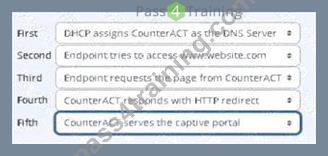
Place the DNS Enforce control actions into the correct workflow order for endpoints which have a pending control action.
Answer:
Explanation:
NEW QUESTION # 60
Which of the following is the best way to brand the CounterACT HTTP pages to look like corporate internal web pages?
- A. Using the "User Portal Builder," modify the CSS for the desired skins
- B. Using the "Reports Portal," modify the CSS for the desired skins
- C. Have a webmaster modify the HTML pages within the Tomcat web server
- D. This is not possible with CounterACT portal and HTTP pages
- E. Using the "User Portal Builder" basic interface
Answer: A
Explanation:
Comprehensive and Detailed Explanation From Exact Extract of Forescout Platform Administration and Deployment:
According to the Forescout Administration Guide, the best way to brand CounterACT HTTP pages to match corporate identity is to use "the 'User Portal Builder' to modify the CSS for the desired skins". This is the officially supported method for customizing the appearance of Forescout portal pages.
User Portal Builder for Branding:
The User Portal Builder provides:
* CSS Customization - Modify cascading stylesheets to match corporate branding
* Skin Selection - Choose different portal skins/themes
* Logo and Colors - Customize logos, color schemes
* Supported Customization - Official, supported method through the GUI
Why Option C is Correct:
The User Portal Builder specifically provides CSS modification capabilities to customize the appearance of Forescout HTTP portal pages to match organizational branding standards.
Why Other Options Are Incorrect:
* A. Reports Portal - Reports Portal is separate from HTTP portal pages; not for branding
* B. Not possible - Customization IS possible through User Portal Builder
* D. Modify HTML in Tomcat - While technically possible, this is NOT supported; may break with updates
* E. Basic interface only - The full User Portal Builder supports CSS modification, not just basic interface Supported Customization Methods:
According to the documentation:
* # User Portal Builder (CSS) - Supported, recommended method
* # Direct Tomcat HTML modification - Not supported; unsupported method
* # Manual CSS editing - Unsupported; may conflict with updates
Referenced Documentation:
* Forescout Administration Guide - User Portal Builder section
NEW QUESTION # 61
Which of the following is a characteristic of a centralized deployment?
- A. Is optimal for threat protection
- B. Deployed as a Layer-2 channel
- C. Provides enhanced IPS and HTTP actions
- D. Every site has an appliance
- E. Checking Microsoft vulnerabilities at remote site may have significant bandwidth impact
Answer: E
Explanation:
Comprehensive and Detailed Explanation From Exact Extract of Forescout Platform Administration and Deployment:
According to the Forescout Installation Guide and Windows Vulnerability DB Configuration Guide, a characteristic of a centralized deployment is that checking Microsoft vulnerabilities at a remote site may have significant bandwidth impact.
Centralized vs. Distributed Deployment Models:
In a centralized deployment, Forescout uses a central location with Enterprise Manager and Appliances, while in a distributed deployment, appliances are placed at multiple locations.
Bandwidth Considerations in Centralized Deployments:
According to the Windows Vulnerability DB Configuration Guide:
"Minimize Bandwidth During Vulnerability File Download: You can minimize bandwidth usage during Microsoft vulnerability file download processes by limiting the number of concurrent HTTP downloads to endpoints. The default is 20 endpoints simultaneously." The documentation further states:
"To customize: Select Tools>Options>HPS Inspection Engine>Windows Updates tab. Define a value in the Maximum Concurrent Vulnerability DB File HTTP Uploads field." This configuration option exists specifically because checking Microsoft vulnerabilities (downloading vulnerability definition files to endpoints and having endpoints upload compliance data back) can consume significant bandwidth.
Why Centralized Deployments Magnify Bandwidth Impact:
According to the Installation Guide:
In a centralized deployment:
* All vulnerability checking traffic flows through a single central location
* Multiple endpoints simultaneously download large vulnerability database files
* All endpoints upload vulnerability compliance data back to central appliances
* All this traffic concentrates at the central site
In contrast, in a distributed deployment where appliances exist at remote sites, local endpoints can communicate directly with the local appliance without impacting the central WAN link.
Bandwidth Management for Centralized Deployments:
According to the documentation:
To address the bandwidth impact in centralized deployments:
* Limit concurrent HTTP uploads for vulnerability DB files
* Schedule vulnerability checks during off-peak hours
* Carefully plan deployment architecture considering remote site bandwidth Why Other Options Are Incorrect:
* B. Provides enhanced IPS and HTTP actions - This is not specific to centralized deployments; both deployment models can use IPS and HTTP actions
* C. Is optimal for threat protection - Neither deployment model is necessarily optimal; choice depends on specific requirements
* D. Deployed as a Layer-2 channel - Deployment mode (Layer-2 vs. Layer-3) is independent of centralized vs. distributed architecture
* E. Every site has an appliance - This describes a distributed deployment, not a centralized one. In centralized deployments, appliances are concentrated at a central site Centralized Deployment Characteristics:
According to the documentation:
* Appliances are typically located at a central site
* Remote sites connect through WAN links
* Reduced operational complexity with centralized management
* Higher bandwidth requirements on WAN for vulnerability checking and policy enforcement
* Requires careful bandwidth planning for remote vulnerability assessment Referenced Documentation:
* Forescout Platform Installation Guide - Network Deployment Requirements
* Windows Vulnerability DB Configuration Guide - Minimize Bandwidth During Vulnerability File Download
* Forescout Platform Cloud Strategies and Best Practices - Bandwidth considerations
NEW QUESTION # 62
Which of the following are endpoint attributes learned from the Switch plugin?
- A. Mac address, Switch IP and Port name, ARP Table, Switch Port Information
- B. Host Name, Mac table, Switch IP, Port Description, Host Table, Switch Version
- C. Port VLAN, Switch Version, Mac address, Host name, Port Description, ARP Table, Switch Version
- D. Mac address, Host name, Port VLAN, Port Description, Switch OS, Switch Version
- E. Switch Version, Mac address, Switch OS, Port VLAN, Host Name, ARP Table
Answer: D
Explanation:
Comprehensive and Detailed Explanation From Exact Extract of Forescout Platform Administration and Deployment:
According to the Forescout Switch Plugin documentation and Switch Properties, the endpoint attributes learned from the Switch plugin are: Mac address, Host name, Port VLAN, Port Description, Switch OS, and Switch Version.
Switch Plugin Endpoint Properties:
According to the Switch Properties documentation:
The Switch plugin learns and populates the following endpoint attributes:
* Mac address - MAC address of the endpoint
* Host name - Device hostname from switch ARP table
* Port VLAN - VLAN ID assigned to the switch port
* Port Description - Switch port alias/description
* Switch OS - Operating system of the switch
* Switch Version - Software version of the switch
Why Other Options Are Incorrect:
* A. Includes "Mac table" and "Host Table" - These are switch resources, not endpoint attributes
* B. Lists "ARP Table" and duplicates "Switch Version" - ARP table is not an endpoint attribute
* D. Includes "ARP Table" - ARP table is a switch resource, not an endpoint attribute
* **E. "Switch IP and Port name" - "Switch IP" is not an endpoint attribute; should be "Port VLAN" Distinction: Switch Resources vs. Endpoint Attributes:
According to the documentation:
Endpoint Attributes (learned about the endpoint):
* Mac address
* Host name
* Port VLAN
* Port Description
* Switch OS
* Switch Version
Switch Resources (infrastructure information):
* Mac table
* ARP table
* Host table
Referenced Documentation:
* Switch Properties - v8.4.4
* Switch Properties - v8.16.h
* Switch Properties - v8.1.x
NEW QUESTION # 63
When configuring policies, which of the following statements is true regarding this image?
- A. Has no effect on irresolvable hosts
- B. Negates the criteria inside the property
- C. The NOT checkbox means the "Evaluate Irresolvable as" should be set to False
- D. The NOT checkbox means the "Evaluate Irresolvable as" should be set to True
- E. The external NOT does not change the meaning of "evaluate irresolvable as"
Answer: B
Explanation:
The NOT checkbox negates the criteria inside the property. According to the Forescout Administration Guide, when the NOT checkbox is selected on a policy condition criteria, it reverses the logic of that specific criterion evaluation.
Understanding the NOT Operator in Policy Conditions:
In Forescout policy configuration, the NOT operator is a Boolean logic operator that inverts the result of the property evaluation. When you select the NOT checkbox:
* Logical Inversion - The condition is evaluated normally, and then the result is inverted
* Criteria Negation - If a criteria would normally match an endpoint, selecting NOT causes it NOT to match
* Property-Level Operation - The NOT operator applies specifically to that individual property/criterion, not to the entire rule Example of NOT Logic:
Without NOT:
* Condition: "Windows Antivirus Running = True"
* Result: Matches endpoints that HAVE antivirus running
With NOT:
* Condition: "NOT (Windows Antivirus Running = True)"
* Result: Matches endpoints that DO NOT have antivirus running
NOT vs. "Evaluate Irresolvable As":
According to the documentation, the NOT operator and "Evaluate Irresolvable As" are independent settings:
* NOT operator - Negates/inverts the criteria evaluation itself
* "Evaluate Irresolvable As" - Defines what happens when a property CANNOT be resolved (is irresolvable) These serve different purposes:
* NOT determines what value to match
* Evaluate Irresolvable As determines how to handle unresolvable properties Handling Irresolvable Criteria:
According to the administration guide documentation:
"If you do not select the Evaluate irresolvable criteria as option, the criteria is handled as irresolvable and the endpoint does not undergo further analysis." The "Evaluate Irresolvable As" checkbox allows you to define whether an irresolvable property should be treated as True or False when the property value cannot be determined. This is independent of the NOT checkbox.
Why Other Options Are Incorrect:
* A. The NOT checkbox means the "Evaluate Irresolvable as" should be set to True - Incorrect; NOT and Evaluate Irresolvable As are independent settings
* B. The external NOT does not change the meaning of "evaluate irresolvable as" - While technically true that NOT doesn't change the Evaluate Irresolvable setting, the answer doesn't explain what NOT actually does
* C. Has no effect on irresolvable hosts - Incorrect; NOT negates the criterion logic regardless of whether it's resolvable
* E. The NOT checkbox means the "Evaluate Irresolvable as" should be set to False - Incorrect; NOT and Evaluate Irresolvable As are independent Policy Condition Structure:
According to the documentation, a policy condition consists of:
* Property criteria combined with Boolean logic operators
* Individual criterion settings including NOT operator
* Irresolvable handling options that are separate from the NOT operator Referenced Documentation:
* Forescout Administration Guide - Define policy scope
* Forescout eyeSight policy sub-rule advanced options
* Handling Irresolvable Criteria section
* Working with Policy Conditions
NEW QUESTION # 64
Which of the following switch actions cannot both be used concurrently on the same switch?
- A. Access Port ACL & Switch Block
- B. Endpoint Address ACL & Assign to VLAN
- C. Switch Block & Assign to VLAN
- D. Access Port ACL & Assign to VLAN
- E. Access Port ACL & Endpoint Address ACL
Answer: E
Explanation:
Comprehensive and Detailed Explanation From Exact Extract of Forescout Platform Administration and Deployment:
According to the Forescout Switch Plugin Configuration Guide, Access Port ACL and Endpoint Address ACL cannot both be used concurrently on the same endpoint. These two actions are mutually exclusive because they both apply ACL rules to control traffic, but through different mechanisms, and attempting to apply both simultaneously creates a conflict.
Switch Restrict Actions Overview:
The Forescout Switch Plugin provides several restrict actions that can be applied to endpoints:
* Access Port ACL - Applies an operator-defined ACL to the access port of an endpoint
* Endpoint Address ACL - Applies an operator-defined ACL based on the endpoint's address (MAC or IP)
* Assign to VLAN - Assigns the endpoint to a specific VLAN
* Switch Block - Completely isolates endpoints by turning off their switch port Action Compatibility Rules:
According to the Switch Plugin Configuration Guide:
* Endpoint Address ACL vs Access Port ACL - These CANNOT be used together on the same endpoint because:
* Both actions modify switch filtering rules
* Both actions can conflict when applied simultaneously
* The Switch Plugin cannot determine priority between conflicting ACL configurations
* Applying both would create ambiguous filtering logic on the switch
Actions That CAN Be Used Together:
* Access Port ACL + Assign to VLAN -#Can be used concurrently
* Endpoint Address ACL + Assign to VLAN -#Can be used concurrently
* Switch Block + Assign to VLAN - This is semantically redundant (blocking takes precedence) but is allowed
* Access Port ACL + Switch Block -#Can be used concurrently (though Block takes precedence) Why Other Options Are Incorrect:
* A. Access Port ACL & Switch Block - These CAN be used concurrently; Switch Block would take precedence
* B. Switch Block & Assign to VLAN - These CAN be used concurrently (though redundant)
* C. Endpoint Address ACL & Assign to VLAN - These CAN be used concurrently
* E. Access Port ACL & Assign to VLAN - These CAN be used concurrently; they work on different aspects of port management ACL Action Definition:
According to the documentation:
* Access Port ACL - "Use the Access Port ACL action to define an ACL that addresses one or more than one access control scenario, which is then applied to an endpoint's switch port"
* Endpoint Address ACL - "Use the Endpoint Address ACL action to apply an operator-defined ACL, addressing one or more than one access control scenario, which is applied to an endpoint's address" Referenced Documentation:
* Forescout CounterACT Switch Plugin Configuration Guide Version 8.12
* Switch Plugin Configuration Guide v8.14.2
* Switch Restrict Actions documentation
NEW QUESTION # 65
......
Easy Success Forescout FSCP Exam in First Try: https://examsboost.pass4training.com/FSCP-test-questions.html
