

Get instant access to Development-Lifecycle-and-Deployment-Architect Practice Tests 2024 Free Updated Today!
Welcome to download the newest PassLeader Development-Lifecycle-and-Deployment-Architect PDF dumps ( 229 Q&As)
Salesforce Development-Lifecycle-and-Deployment-Architect certification is highly valued in the Salesforce community and can lead to exciting career opportunities. Salesforce Certified Development Lifecycle and Deployment Architect certification demonstrates that the holder has the skills and expertise to manage the entire development lifecycle of a Salesforce application, from design to deployment. By earning this certification, professionals can increase their credibility and marketability in the Salesforce job market and gain access to higher-paying job opportunities.
To prepare for the Salesforce Development-Lifecycle-and-Deployment-Architect Certification Exam, candidates should have a solid understanding of Salesforce's development platform, including Apex, Visualforce, and Lightning Components. They should also be familiar with the Salesforce data model and have experience designing and implementing complex solutions that integrate with other systems. Candidates can prepare for the exam by taking online courses, reading books and articles, and practicing with sample exam questions.
NEW QUESTION # 76
Universal Containers is delivering many changes to its Salesforce system. Adoption reports are discovering that many features are unused. The steering committee wants this to change and is looking to the architect for advice.
What should an architect recommend to overcome this?
- A. Using Lightning Web Components for every user interface.
- B. Sending weekly communication emails reporting on least engaged users
- C. Stop development until current features start being used.
- D. Adopting user centered design to understand user needs before building the solution.
Answer: D
NEW QUESTION # 77
Universal Containers has several concurrent projects building new functionality, fixing bugs, and modifying existing functionality. Management would like features to be available to users as quickly as possible, even if the entire project is incomplete. What should an Architect recommend to maintain quality?
- A. Deploy all functionality together to ensure all functionality works together without error
- B. Use a spreadsheet to track approved changes that should be released with change sets
- C. Require developers to deploy completed code and unit tests directly to production
- D. Utilize automated source control, test, and build systems to test and deploy to production
Answer: D
NEW QUESTION # 78
Universal Containers has a complex deployment coming up. The deployment will include several Apex classes which depend on custom settings that hold important configuration. How should an Architect manage this deployment?
- A. Create a custom metadata type and include this in your deployment to production
- B. Script the deployment of all functionality via the Force.com Migration Tool
- C. Manually deploy and populate custom settings in production using a change set
- D. Manually deploy and populate the custom settings in production prior to the Apex Class deployment
Answer: A
NEW QUESTION # 79
Universal Containers is in the final stages of building a new application to track custom containers. During a review of the application, a business subject Matter Expert mentioned that it would be nice to be able to track additional container types beyond what was originally scoped during the plan and design phase. Which two actions should be performed to mitigate the risk? Choose 2 answers.
- A. Escalate and communicate to stakeholders the risk and mitigate it by allocating additional resources to support the new requirement based on stakeholders input.
- B. Escalate and communicate to stakeholders the risk and mitigate it by extending the timeline of the project to support the new requirement based on stakeholders input.
- C. Have a discussion with the business subject Matter Expert and communicate that the Salesforce has limitations in supporting such a feature to mitigate the risk.
- D. Have a discussion with the business subject Matter Expert and communicate that anew developer environment will be needed to mitigate the risk.
Answer: A,B
NEW QUESTION # 80
Which two decisions should be made by an Architecture Review Board (ARB)? Choose 2 answers
- A. Whether to utilize the Waterfall or Agile methodology on the project
- B. Whether to create a new Salesforce object or override an existing object using a new Record Type
- C. What testing tools should be used to track integration testing requirements
- D. Whether to implement Single Sign -On with SAML or delegated authentication
Answer: A,D
Explanation:
Explanation
B and D are the decisions that should be made by an Architecture Review Board (ARB), as they involve choosing the best methodology and authentication mechanism for the project, which have significant impacts on the project scope, quality, and security. A is not a decision that should be made by an ARB, as it is a low-level design decision that can be made by the developers or technical leads. C is not a decision that should be made by an ARB, as it is a testing decision that can be made by the testers or quality assurance leads.
NEW QUESTION # 81
Which statement is true for the Staging sandbox in the following diagram?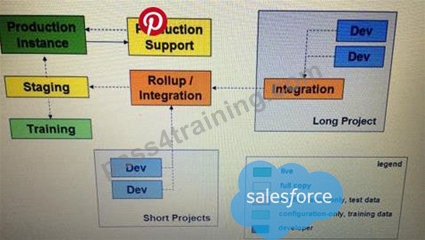
- A. The Staging environment can only be updated once every two weeks
- B. Salesforce major releases (e.g., Winter to Spring) always occur in Staging and Production at the same time
- C. When created or refreshed, the Staging sandbox is a full replica of Production
- D. The Staging sandbox is automatically refreshed on a schedule set by the administrator
Answer: C
NEW QUESTION # 82
Universal Containers (UC) is midway through a large enterprise project. UC is working in an agile model, and currently has four-week iterations, with a branching strategy supporting this approach. UC operates in a strict regulatory environment, and has dedicated teams for security, QA, and release management. The system is live with users, and a serious production issue is identified at the start of a sprint, which is narrowed down to a bug in some Apex code.
Which three approaches should an architect recommend to address this bug?
Choose 3 answers
- A. Fix the bug in a hotfix branch.
- B. Seek stakeholder approval for the hotfix.
- C. Investigate potential data impacts.
- D. Attempt to fix the bug directly in production.
- E. Wait until the next release to deploy the fix.
Answer: A,B,C
NEW QUESTION # 83
A Salesforce Administrator has initiated a deployment using a change set. the deployment has taken more time than usual. What is the potential reason for this?
- A. The change set performance is independent of the included components.
- B. The change set includes changes to permission sets and profiles.
- C. The change set includes new custom objects and custom fields.
- D. The change set includes Field type changes for some objects.
Answer: B
Explanation:
Explanation
The change set performance may depend on the included components, especially if they are complex or have many dependencies. The change set may take more time than usual if it includes changes to permission sets and profiles, as these components require additional validation and processing. The change set may not take more time if it includes field type changes, new custom objects and fields, or other simple components.
NEW QUESTION # 84
Universal Containers (UC) is implementing Salesforce for the first time. Their legacy CRM system is an on-premise home-grown application written in Java. UC plans to implement a continuous integration process that mirrors their current standard. Under what conditions should an Architect recommend against continuous integration?
- A. The client does not have the budget for additional software
- B. Test scripts will be generated as part of the testing phase
- C. The Salesforce instance has only standard functionality
- D. There isn't a full sandbox available to leverage
Answer: C
Explanation:
Explanation
The only condition that would make continuous integration unsuitable for UC is if their Salesforce instance has only standard functionality, as this would mean that there is no need for code deployment or version control. Option A is not a valid reason, as test scripts can be generated and executed as part of the continuous integration process. Option B is not a valid reason, as a full sandbox is not a requirement for continuous integration, and other types of sandboxes can be used instead. Option D is not a valid reason, as there are free or low-cost software tools available for continuous integration, such as Jenkins, Git, and Ant
NEW QUESTION # 85
Universal Containers operates from North America and does business within North Americ a. UC has just acquired a local company in Asia to start operating from Asia. Currently, these two business units operate in two different languages. Both units have different sales processes and have to comply strictly with local laws. During the expansion phase, UC would like to focus on innovation over standardization. What should an architect recommend given the scenario?
- A. Opt for Single-org strategy, standardized sales process, common rules, and business unit-specific locale
- B. Opt for Multi-org strategy, standardized sales process, common rules, and same locale across orgs.
- C. Opt for Single-org strategy, standardized sales process, common rules, and same locale for all business units.
- D. Opt for Multi-org strategy, each org have its own sales process, common rules and operate in locale
Answer: D
NEW QUESTION # 86
Universal Containers (UC) is considering updating their Salesforce Release Management process. Which three best practices should UC consider for Release Management? Choose 3 answers
- A. Design the right sandbox strategy for the release.
- B. Maintain a pre/post deployment checklist for each release.
- C. Regression testing is mandatory for each release.
- D. Release sign-off is only required for Production.
- E. Publish a release calendar for each phase of the release.
Answer: A,B,E
NEW QUESTION # 87
Which two groups are responsible for the creation and execution of Release Management processes? Choose 2 answers
- A. Steering Committee
- B. Dev/Build Team
- C. Center of Excellence
- D. End Users
Answer: B,C
Explanation:
Explanation
The creation and execution of Release Management processes are the responsibility of the Dev/Build Team and the Center of Excellence. The Dev/Build Team is in charge of developing, testing, and deploying the changes to the system, while the Center of Excellence is in charge of defining and managing the best practices, standards, and governance for the system. The Steering Committee is a group of senior stakeholders that provides strategic direction and oversight for the project, but does not create or execute the Release Management processes. The End Users are the people who use the system, but do not create or execute the Release Management processes.
NEW QUESTION # 88
There has been an increase in the number of defects. Universal Containers (UC) found the root cause to be decreased in quality of code. Which two options can enforce code quality in UC's continuous integration process? Choose 2 answers
- A. Introduce manual code review before deployment to the production org.
- B. Introduce static code analysis before deployment to the testing sandbox.
- C. Increase the size of the testing team assigned to the project.
- D. Introduce manual code review before deployment to the testing sandbox.
Answer: B,D
Explanation:
Explanation
The best options to enforce code quality in UC's continuous integration process are to introduce manual code review before deployment to the testing sandbox and to introduce static code analysis before deployment to the testing sandbox. Manual code review can help identify and fix any errors, bugs, or best practices violations in the code. Static code analysis can help check the code quality, complexity, and security using automated tools and standards. Introducing manual code review before deployment to the production org may be too late, as the code may have already caused defects or issues in the testing sandbox. Increasing the size of the testing team assigned to the project may not improve the code quality, as the testing team may not have the skills or authority to review or modify the code. Testing data creation is outside the scope of code quality.
NEW QUESTION # 89
Universal Containers are concerned that after each release, reports and dashboards seem to roll back to previous versions. Executives spend many hours crafting these dashboards to perfectly meet their needs, and are now questioning the Salesforce platform's ability to save things, even data records.
What can the Salesforce architect advise to stop the rollbacks from happening?
- A. Back up all the reports just before the release, then reimport them after the release,
- B. Ensure report metadata is exported daily and that it is merged into the developer branches before the next release.
- C. Use a third-party data warehouse.
- D. Remove the executive's ability to change reports, and only allow developers to do that.
Answer: B
Explanation:
Explanation
The best way to stop the rollbacks from happening is to ensure report metadata is exported daily and that it is merged into the developer branches before the next release. This way, the reports and dashboards will be up to date and consistent across all environments. Using a third-party data warehouse is not a solution, as it does not address the root cause of the rollbacks. Removing the executive's ability to change reports is not a good practice, as it limits their flexibility and autonomy. Backing up and reimporting the reports before and after the release is not a reliable or scalable solution, as it can introduce errors and inconsistencies.
NEW QUESTION # 90
Universal Containers is a Salesforce AppExchange partner and they are planning to launch recommended that they use a partner development org for development. New app. The technical architect What are the three benefits of using a partner development org over an individual development org in this scenario?
Choose 3 answers
- A. Partner development org has a greater number of licenses available for the team.
- B. Partner development org never expires.
- C. Only partner development org supports managed beta testing.
- D. Partner development org offers higher API limit.
- E. Partner development org offers more storage.
Answer: A,D,E
NEW QUESTION # 91
Universal Containers (UC) is using Salesforce for their sales organization. The sales users have created several dashboards using multiple running users. The admins have also added a few workflow rues that send email notifications to some sales users. What should an Architect consider while planning the deployment of such components? Choose 2 answers
- A. If the username in the source org doesn't exist in the target org, the deployment will continue and Salesforce will automatically create the username in the target org.
- B. If the username in the source org doesn't exist in the target org, the deployment will stop until the usernames are resolved or removed.
- C. User Fields are preserved during metadata deployments and Salesforce attempts to locate a matching user in the target org during deployment.
- D. User fields are ignored during metadata deployments and all such users need to be manually created in the target org before starting the deployment.
Answer: B,C
NEW QUESTION # 92
Universal Containers have just acquired Planetary storage. Both companies use salesforce.com to manage their sales activities. The two companies have many customers in common and the company plans to merge the two sales organizations, but the products and sales processes between the two original companies will remain different and distinct. What factor should the company consider in merging the two Salesforce.com orgs into a single org?
- A. Salespersons selling both product lines would need two logins, once for each product line
- B. Business processes on standard objects can be merged without modifications
- C. Transactional sales data could be combined without modification since standard objects are used
- D. Customer data could be merged with modifications using standardization and de -duplication
Answer: D
NEW QUESTION # 93
Universal Containers CUC) is an enterprise financial company that operates in EMEA, AMER, and APAC.
Because of regulatory requirements, UC has a separate Salesforce org for each region. Each org has its own customizations that fit for the region needs, but there are also standard processes that apply to all regions requirements.
As the deployment architect, what should be considered for the multi-org deployment strategy?
- A. Deploy metadata to production orgs using unmanaged packages.
- B. Deploy metadata to production orgs using managed packages.
- C. Deploy metadata to production orgs using package development model.
- D. Deploy metadata to production orgs using change sets.
Answer: C
Explanation:
Explanation
Deploying metadata to production orgs using package development model is the best option for the multi-org deployment strategy, as it allows you to create modular and reusable packages that can be easily installed and updated across different orgs. Deploying metadata to production orgs using managed packages is not suitable for this scenario, as managed packages are typically used by ISVs to distribute their applications to customers, and they have some limitations and restrictions that may not fit the requirements of UC. Deploying metadata to production orgs using unmanaged packages is also not a good option, as unmanaged packages are mainly used for one-time distribution of components, and they do not support upgrades or dependencies. Deploying metadata to production orgs using change sets is not feasible for this scenario, as change sets can only be used to deploy metadata between connected orgs in the same Salesforce instance, and UC has separate orgs for each region. See [Package Development Model] for more details.
NEW QUESTION # 94
Universal Containers wants to implement a release strategy with major releases every four weeks and minor releases every week. Major releases follow Development, System Testing (SIT), User Acceptance Testing (UAT) and Training Minor releases follow Development and User Acceptance Testing (UAT) stages. What represents a valid environment strategy consideration for UAT?
- A. Minor releases use Developer and Major releases Full copy
- B. Minor and Major releases use separate Developer pro
- C. Minor and Major releases use same Full copy.
- D. Minor releases use Partial copy and Major releases use Full copy
Answer: D
NEW QUESTION # 95
Universal Containers (UC) development team is using an Agile tool to track the status of build items, but only in terms of stages. UC is not able to track any effort estimates, log any hours worked, or keep track of remaining effort. For what reasons should UC consider using the agile tool for effort tracking?
- A. Allows the Developer to compare their effort, estimates and actuals to better adjust their future estimates.
- B. Allows the management team to manage the performance of bad developers who are slacking off.
- C. Allows the management team to make critical timeline commitments based solely on developer estimates.
- D. Allows the organization to track the Developers work hours for salary compensation purposes.
Answer: A
NEW QUESTION # 96
Universal Containers (UC) uses a managed package to install an internal Sales app in five orgs. Within each org there are integrations and local processes with the objects of the managed package. UC wants to use unlocked packages for better integration with CI/CD processes.
What would the Salesforce architect recommend for this migration?
- A. Migrate all classes, Visualforce, and components from the managed package to the unlocked package.Install the new version of the managed package (objects/fields only)and the unlocked package with the other components.
- B. Export all data from objects/fields of the managed package, uninstall it, install the unlocked package with the same namespace as the Managed package and restore all data.
- C. Export all data from objects/fields of the managed package, uninstall it, install the unlocked package without namespace and restore all data.
- D. Do not change to unlocked package as it is possible to perform all CI/CD processes with the managed package.
Answer: A
Explanation:
Explanation
The best way to migrate from a managed package to an unlocked package is to split the components into two packages: one for the objects and fields, and one for the classes, Visualforce, and other components. This way, the data and integrations with the objects and fields of the managed package are preserved, and the classes and Visualforce can be modified and deployed using CI/CD processes with the unlocked package. Exporting and restoring the data from the managed package is not a feasible solution, as it would require a lot of effort and risk data loss or corruption. Installing the unlocked package with the same namespace as the managed package is not possible, as namespaces are unique and cannot be reused. Staying with the managed package is not a good option, as it does not allow for better integration with CI/CD processes.
NEW QUESTION # 97
Universal Containers has automated its deployment process using Metadata API. However, they found that Metadata API doesn't support all the components yet. What should be done to address this?
- A. Use AppExchange products to deploy unsupported components.
- B. Use change sets for deploying all the unsupported components.
- C. Deploy unsupported components manually before/after deployment.
- D. Use the force.com IDE for deploying the unsupported components.
Answer: C
NEW QUESTION # 98
......
May-2024 Latest Pass4training Development-Lifecycle-and-Deployment-Architect Exam Dumps with PDF and Exam Engine: https://examsboost.pass4training.com/Development-Lifecycle-and-Deployment-Architect-test-questions.html
