

[Nov 25, 2023] Qlik QSDA2022 Real Exam Questions and Answers FREE
Pass Qlik QSDA2022 Exam Info and Free Practice Test
NEW QUESTION # 21
A data architect needs to build an Order Fulfillment app. The business requires front-end performance is optimized.
The OrderDate and ShipmentDate are located in different tables.
The user needs to identify thedata type and must be able to:
* Show trends for orders and shipments
* Use a single filter for both date fields
* Analyze data over fiscal periods
Which steps should the data architect take to build the data model?
- A. 1. Create a master calendar andjoin into the Shipments and Orders table
2. Create a single filter using fields from the Shipments table - B. 1. Create a master calendar table as a data island
2. Create a single filter using fields from the master calendar - C. 1. Load the Shipments and Orders table via the data manager
2. Create a single filter using fields from the Orders table - D. 1. Create a link table with master calendar fields
2. Create a single filter using fields from the master calendar
Answer: D
NEW QUESTION # 22
A human resources (HR) team manager is due to go on leave. The manager needs to assign permissions to colleague to help the HR team publish apps. Which action(s) should the manager assign to the colleague before going on leave?
- A. Owner Publish, Read
- B. Owner Publish
- C. Publish, Read
- D. Publish
Answer: B
Explanation:
Explanation
The Owner Publish permission allows the colleague to publish apps on behalf of the manager, allowing the HR team to continue to publish apps while the manager is away. The other options, Publish, Owner Publish, Read, and Publish, Read, do not provide the colleague with the necessary permissions to publish apps on behalf of the manager.
NEW QUESTION # 23
Refer to the exhibit.
A business analyst reports that the 'CompanyAge' field does NOT display for users The data architect examines the LOAD script and wants to place the breakpoint in the script to check the field name.
Which line number should the data architect use?
- A. 251 because the field name appears in the Qlik Log files
- B. 242 because field name appears in the output Panel of the debugger
- C. 251 because the field name appears in the Variable panel of the debugger
- D. 251 because the field name appears in the Output panel of the debugger
Answer: D
NEW QUESTION # 24
Refer to the exhibit.
A data architect is working with an app and creates some visualizations to check the data. Some visualizations showissues in the data set.
* The Sales by Country table shows a total OrderValue of 18,300 sales while the KPI shows a total OrderValue of 20,600.
* The Sales monthly trend bar chart does not work with the Month field.
Which two data issues should the data architect fix in the app? (Select two.)
- A. The OrderDate field values in the Calendar table do not match with the values in the OrderDate field from the Orders table
- B. In the Orders table, some CustomerlD values are null because there are orders with no customer.
and needs to be incorporated in the table using the Calendar table, null because there are orders with no customer - C. In the Orders table, some values in the CustomerlD field do not exist in the Customers table.
- D. The Month field does not exist in the Orders table and needs to be incorporated in the table using he Calendar table.
Answer: A,C
NEW QUESTION # 25 
Refer to the exhibits.
The first table, Mastersports, contains the master list of all sport names that need to be loaded into the app. The second table, TeamMembers, containsthe teams and team members registered for specific sports.
In a Qlik Sense app, a data architect is loading the two tables that need to be linked together based on the Sport field. The table format cannot be changed in the source.
What should the dataarchitect do in the data load editor?
- A. Apply a preceding LOAD from the TeamMembers table with the SUBFIELD function and rename the field to Sport
- B. Apply a preceding LOAD to the MasterSports table with the SUBFIELD function to create the Sport field
- C. Apply a FOR loop to load to the MasterSports table creating the values for the Sport field
Answer: C
NEW QUESTION # 26
A data architect needs to load Table_A from an Excel file and sort the data by Field_2.
Which script should the data architect use?
A)
B)
C)
D)
- A. Option B
- B. Option C
- C. Option D
- D. Option A
Answer: C
NEW QUESTION # 27
A data architect needs to revise an existing app.
The number of data rows has grown rapidly recently. While the app is in production, users are becoming increasingly unhappy about the response times when they make selections Which two methods should be used toimprove performance? (Select two.)
- A. Create master items for all complex expressions
- B. Use flags in the data model to simplify set analysis
- C. Denormalize the schema
- D. Make sure any Ul variables are preceded by '='
- E. Use dynamic script generation with variables
Answer: B,E
NEW QUESTION # 28 
Refer to the exhibit
A data architect develops an app for Coffee4all, a coffee company with stores located throughout Europe The script runs successfully, but the Stores table does not have any values.
What should the data architect do?
- A. Use Concatenate before loading the Stores table
- B. Use where exists (ID, StorelD)
- C. Use where exists (ID)
Answer: C
NEW QUESTION # 29
A company decides to migrate all apps from QlikView to Qlik Sense. After converting an apps: there are several unconverted objects What should the data architect do?
- A. Save the unconverted objects as extensions and import them into Qlik Sense
- B. Re-create the unconverted objects
- C. Save the unconverted objects as master items
- D. Remove the set analysis statements from the unconverted objects
Answer: B
Explanation:
Explanation
After migrating an app from QlikView to Qlik Sense, there may be some unconverted objects. In this case, the data architect should re-create the unconverted objects in order to ensure that the app works properly in Qlik Sense. The other options will not work, as saving the unconverted objects as extensions or master items will not ensure that the app works properly, and removing set analysis statements will not help either.
qlik-sense-certification-exam-study-guide-en.pdf
https://www.qlik.com/us/-/media/files/training/global-us/qlik-sense-certification-exam-study-guide-en.pdf?la=en Talk to Experts Tuesday - Migrating from QlikView to Qlik Sense FAQ
https://community.qlik.com/t5/Support-Knowledge-Base/Talk-to-Experts-Tuesday-Migrating-from-QlikView-to Certifications & Qualifications | Qlik
https://www.qlik.com/us/services/training/certifications-and-qualifications
NEW QUESTION # 30
Refer to the exhibit.
USER1 has an app protected using this Section Access statement.
Which countries can USER1 see in the app''
- A. Germany Italy, The Netherlands
- B. Italy, United Kingdom, The Netherlands
- C. Italy, The Netherlands
- D. Germany. Italy, United Kingdom, The Netherlands
Answer: B
NEW QUESTION # 31
The Marketing department is using some similar KPIs in different apps that need to be modified frequently according to the business needs. The KPIs are created using master items with the same expression.
Which method should the data architect use to manage the modifications in all apps?
- A. Create a selection app with all the master items and use an on-demand app generation method.
- B. Create a variable repository and load them using INCLUDE statements in the apps where needed
- C. Create a core app with all the master items needed and use a BINARY load in the other apps.
- D. Create only a single app with allthe master items needed and protect it with SECTION ACCESS.
Answer: B
Explanation:
Explanation
This method allows the data architect to store the KPIs in a single repository and then use INCLUDE statements to load them into the other apps. This makes it easy to modify the KPIs inone place and have the changes reflected in all the apps.Source: Qlik A variable repository is a centrallocation where all of the master items used in the apps can be stored and managed. By creating a variable repository and loading the master items into each app using INCLUDE statements, the data architect can make modifications to the master items in oneplace, and the changes will be automatically propagated to all of the apps that use the master items.
This method allows for easy management of the master items and eliminates the need to make changes to each app individually, which can be time-consuming and prone to errors.
NEW QUESTION # 32
Refer to the exhibit.
The data architect needs to build a model that contains Sales and Budget data for each customer.
Some customers have Sales without a Budget, and other customers have a Budget with no Sales During loading, the data architect resolves a synthetic key by creating the composite key For validation, the data architect creates a table containing Customer, Month. Sales, and Budget columns.
What does the data architect see when selecting a month?
- A. Customer and Budget records for that month, but missing values for Sales
- B. Customer and Sales records for that month, but missing values for Budget
- C. Customer, Sales, and Budget records for that month
- D. All Customers, all Budget and all Sales records
Answer: C
NEW QUESTION # 33 
A company has different departments.
Executive and Sales should always be the first values in a Department filter pane.
Which script must the data architect use to meet this requirement?
- A.
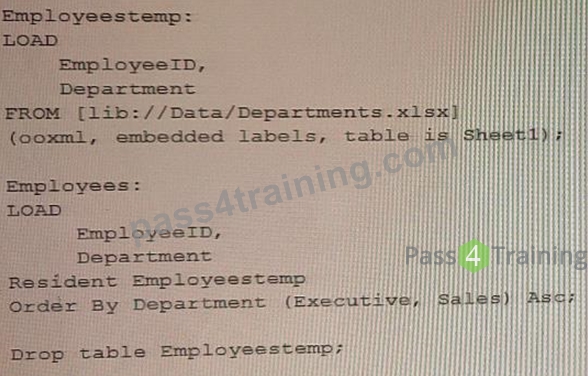
- B.

- C.

- D.

Answer: C
NEW QUESTION # 34
A data architect needs to develop multiple apps for various departments.
More departments are requesting apps over time The company uses specific requirementsfor the number interpretation variables (e.g., ThousandSep, DecimalSep) found at the beginning of a LOAD script.
The data architect wants to reduce duplicate scripts but does not want to copy and paste the number interpretation variables each time new appis created. The data architect prefers to use the least amount of script in Qlik Sense.
How should the data architect meet these requirements?
- A. Save the script for the number interpretation variables in a text file and INLUDE function to insert the variables
- B. Save the script for the number interpretation variables in a text file and use the CALL function to insert the variables.
- C. Create an Excel file with the number interpretation variables and apply the variables to the app using a mapping table
- D. Create an Excel file with the number interpretation variables and use a FOR Next loop to load the variables into Qlik Sense
Answer: A
Explanation:
Explanation
This method involves saving the script for the number interpretation variables in a separate text file, and then using theINCLUDE function to insert the variables into each new app script that is created. This reduces the need to copy and paste the number interpretation variables each time a new app is created and allows the data architect to use the least amount of script in Qlik Sense.
The INCLUDE function is a script statement that allows you to insert the contents of one script file into another script file. This can be used to insert common scripts, such as the number interpretation variables, into multiple app scripts.
NEW QUESTION # 35
A data architect needs to create an app that combines employee data from the Sales system and the Human Resources (HR) system.
These systems identify employees differently Employees in the HR system are identified with an alpha-numeric key Employees in the Sales system are identified using an integer key.
The Human Resources manager creates a table that maps these keys to another, called Associations.
The resultant data model must meet the following requirements:
* Associations must be valid
* The model must be optimized for performance
* The option must support multiple tables added
Which solution should the data architect use to meet these requirements?
- A. MAPSUBSTRING ( 'Associations' ,EMployeekey) As Employeekey;
- B. MAP EmloyeeKey USING Associations;
- C. RENAME FIELDS USING Associations;
- D. APPLYMAP ( 'Associations , EmployeeKey ) as Employeekey;
Answer: B
Explanation:
Explanation
The MAP function maps the EmployeeKey in the Sales system to the EmployeeKey in the HR system using the Associations table. This allows the data architect to join the data from the Sales system and the HR system using the same key, ensuring that the associations are valid.
Using the MAP function also optimizes the performance of the data model as it eliminates the need for multiple joins between the data from the Sales and HR systems.
This solution also supports multiple tables added, as the MAP function can be applied to any table that needs to be joined with the HR system data.
NEW QUESTION # 36 
Refer to the exhibits.
An app is built to analyze salesperson performance by department. Departments are unique within the Departments table, but Salespeople often move between departments. A strict business rule states that a salesperson must be associated with ONLY one department at all times.
The data architect creates a summary of department performance and notices the values are incorrect. The total sales KPI shows the correct result.
How should the data architect modify the data model to correct this issue?
- A. Create a bridge table between the Departments and Salespeople tables to resolve the many-to-many relationship
- B. Create a bridge table between the Transactions and Salespeople tables to resolve the many-to-many relationship
- C. Join the Transactions and Salespeople tables to resolve the many-to-many relationship
- D. Join theDepartments and Salespeople tables to resolve the many-to-many relationship
Answer: A
NEW QUESTION # 37
Refer to the exhibit.
A data architect loads sales data and creates a table which shows only customers who made purchases in 2018 and 2019. The data architect applies the following set analysis expression on the sales measure.
Count<{<Year={'2 018'}, CustomerID=P({<Year={'2019*}>})>} Customer ID)
Which option shows the resulting table after the expression is applied?
A)
B)
C)
D)
- A. Option B
- B. Option C
- C. Option D
- D. Option A
Answer: C
NEW QUESTION # 38
......
Latest QSDA2022 Exam Dumps Qlik Exam: https://examsboost.pass4training.com/QSDA2022-test-questions.html
