

[Dec-2024] CCST-Networking Dumps PDF - CCST-Networking Real Exam Questions Answers
CCST-Networking Dumps 100% Pass Guarantee With Latest Demo
NEW QUESTION # 12
You want to store files that will be accessible by every user on your network.
Which endpoint device do you need?
- A. Access point
- B. Server
- C. Hub
- D. Switch
Answer: B
Explanation:
To store files that will be accessible by every user on a network, you would need aserver. A server is a computer system that provides data to other computers. It can serve data to systems on a local network (LAN) or a wide network (WAN) over the internet.In this context, a file server would be set up to store and manage files, allowing users on the network to access them from their own devices1.
References:=
* What is a Server?
* Understanding Servers and Their Functions
A server is a computer designed to process requests and deliver data to other computers over a local network or the internet. In this case, to store files that will be accessible by every user on the network, a file server is the appropriate endpoint device. It provides a centralized location for storing and managing files, allowing users to access and share files easily.
* A. Access point: Provides wireless connectivity to a network.
* C. Hub: A basic networking device that connects multiple Ethernet devices together, making them act as a single network segment.
* D. Switch: A networking device that connects devices on a computer network by using packet switching to forward data to the destination device.
Thus, the correct answer is B. Server.
References:=
* File Server Overview (Cisco)
* Server Roles in Networking (Cisco)
NEW QUESTION # 13
You want to list the IPv4 addresses associated with the host name www.companypro.net.
Complete the command by selecting the correct option from each drop-down list.
Answer:
Explanation:
Explanation:
To list the IPv4 addresses associated with the host name www.companypro.net, you should use the following command:
nslookup www.companypro.net
This command will query the DNS servers to find the IP address associated with the hostname provided.If you want to ensure that it returns the IPv4 address, you can specify the-type=Aoption, which stands for Address records that hold IPv4 addresses1. However, thenslookupcommand by default should return the IPv4 address if available.
To list the IPv4 addresses associated with the host namewww.companypro.net, you should use thenslookup command.
* Command: nslookup
* Target:www.companypro.net
So, the completed command is:
* nslookupwww.companypro.net
* nslookup: This command is used to query the Domain Name System (DNS) to obtain domain name or IP address mapping or for any other specific DNS record.
* www.companypro.net: This is the domain name you want to query to obtain its associated IP addresses.
References:
* Using nslookup: nslookup Command Guide
NEW QUESTION # 14
Which wireless security option uses a pre-shared key to authenticate clients?
- A. 802.1q
- B. 802.1x
- C. WPA2-Personal
- D. WPA2-Enterprise
Answer: C
Explanation:
WPA2-Personal, also known as WPA2-PSK (Pre-Shared Key), is the wireless security option that uses a pre-shared key to authenticate clients. This method is designed for home and small office networks and doesn't require an authentication server. Instead, every user on the network uses the same key or passphrase to connect1.
References :=
*What is a Wi-Fi Protected Access Pre-Shared Key (WPA-PSK)?
*Exploring WPA-PSK and WiFi Security
*WPA2-Personal: This wireless security option uses a pre-shared key (PSK) for authentication. Each client that connects to the network must use this key to gain access. It is designed for home and small office networks where simplicity and ease of use are important.
*WPA2-Enterprise: Unlike WPA2-Personal, WPA2-Enterprise uses 802.1x authentication with an authentication server (such as RADIUS) and does not rely on a pre-shared key.
*802.1x: This is a network access control protocol for LANs, particularly wireless LANs. It provides an authentication mechanism to devices wishing to attach to a LAN or WLAN.
*802.1q: This is a networking standard that supports VLAN tagging on Ethernet networks and is not related to wireless security.
References:
*Cisco Documentation on WPA2 Security: Cisco WPA2
*Understanding Wireless Security: Wireless Security Guide
NEW QUESTION # 15
Move each protocol from the list on the left to the correct TCP/IP model layer on the right.
Note: You will receive partial credit for each correct match.
Answer:
Explanation:
Explanation:
Here's how each protocol aligns with the correct TCP/IP model layer:
* TCP (Transmission Control Protocol): This protocol belongs to theTransportlayer, which is responsible for providing communication between applications on different hosts1.
* IP (Internet Protocol): IP is part of theInternetworklayer, which is tasked with routing packets across network boundaries to their destination1.
* FTP (File Transfer Protocol): FTP operates at theApplicationlayer, which supports application and end-user processes.It is used for transferring files over the network1.
* Ethernet: While not a protocol within the TCP/IP stack, Ethernet is associated with theNetwork Interfacelayer, which corresponds to the link layer of the TCP/IP model and is responsible for the physical transmission of data1.
The TCP/IP model layers are designed to work collaboratively to transmit data from one layer to another, with each layer having specific protocols that perform functions necessary for the data transmission process1.
* TCP:
* TCP Model Layer: Transport
* Explanation: The Transport layer is responsible for end-to-end communication and error handling. TCP (Transmission Control Protocol) operates at this layer to provide reliable, ordered, and error-checked delivery of data.
* IP:
* TCP Model Layer: Internetwork
* Explanation: The Internetwork layer, also known as the Internet layer, is responsible for logical addressing and routing. IP (Internet Protocol) operates at this layer to route packets across networks.
* FTP:
* TCP Model Layer: Application
* Explanation: The Application layer provides network services to applications. FTP (File Transfer Protocol) operates at this layer to transfer files between computers over a network.
* Ethernet:
* TCP Model Layer: Network
* Explanation: The Network layer, also known as the Link layer in the TCP/IP model, is responsible for physical addressing and access to the physical medium. Ethernet operates at this layer to provide the physical and data link functions.
* Transport Layer: This layer is responsible for providing communication services directly to the application processes running on different hosts. TCP is a core protocol in this layer.
* Internetwork Layer: This layer is responsible for logical addressing, routing, and packet forwarding.
IP is the primary protocol for this layer.
* Application Layer: This layer interfaces directly with application processes and provides common network services. FTP is an example of a protocol operating in this layer.
* Network Layer: In the TCP/IP model, this layer includes both the data link and physical layers of the OSI model. Ethernet is a protocol used in this layer to define network standards and communication protocols at the data link and physical levels.
References:
* TCP/IP Model Overview: Cisco TCP/IP Model
* Understanding the TCP/IP Model: TCP/IP Layers
NEW QUESTION # 16
A user initiates a trouble ticket stating that an external web page is not loading. You determine that other resources both internal and external are still reachable.
Which command can you use to help locate where the issue is in the network path to the external web page?
- A. nslookup
- B. tracert
- C. ping -t
- D. ipconfig/all
Answer: B
Explanation:
The tracert command is used to determine the route taken by packets across an IP network. When a user reports that an external web page is not loading, while other resources are accessible, it suggests there might be an issue at a certain point in the network path to the specific web page. The tracert command helps to diagnose where the breakdown occurs by displaying a list of routers that the packets pass through on their way to the destination. It can identify the network segment where the packets stop progressing, which is valuable for pinpointing where the connectivity issue lies. References := Cisco CCST Networking Certification FAQs - CISCONET Training Solutions, Command Prompt (CMD): 10 network-related commands you should know, Network Troubleshooting Commands Guide: Windows, Mac & Linux - Comparitech, How to Use the Traceroute and Ping Commands to Troubleshoot Network, Network Troubleshooting Techniques: Ping, Traceroute, PathPing.
*tracert Command: This command is used to determine the path packets take to reach a destination. It lists all the hops (routers) along the way and can help identify where the delay or failure occurs.
*ping -t: This command sends continuous ping requests and is useful for determining if a host is reachable but does not provide path information.
*ipconfig /all: This command displays all current TCP/IP network configuration values and can be used to verify network settings but not to trace a network path.
*nslookup: This command queries the DNS to obtain domain name or IP address mapping, useful for DNS issues but not for tracing network paths.
References:
*Microsoft tracert Command: tracert Command Guide
*Troubleshooting Network Issues with tracert: Network Troubleshooting Guide
NEW QUESTION # 17
During the data encapsulation process, which OSI layer adds a header that contains MAC addressing information and a trailer used for error checking?
- A. Data Link
- B. Transport
- C. Session
- D. Network
Answer: A
Explanation:
OSI model
During the data encapsulation process, theData Link layerof the OSI model is responsible for adding a header that contains MAC addressing information and a trailer used for error checking.The header typically includes the source and destination MAC addresses, while the trailer contains a Frame Check Sequence (FCS) which is used for error detection1.
The Data Link layer ensures that messages are delivered to the proper device on a LAN using hardware addresses and translates messages from the Network layer into bits for the Physical layer to transmit. It also controls how data is placed onto the medium and is received from the medium through the physical hardware.
References:=
* The OSI Model - The 7 Layers of Networking Explained in Plain English
* OSI Model - Network Direction
* Which layer adds both header and trailer to the data?
* What is OSI Model | 7 Layers Explained - GeeksforGeeks
NEW QUESTION # 18
What is the purpose of assigning an IP address to the management VLAN interface on a Layer 2 switch?
- A. To enable the switch to resolve URLs for the attached the devices
- B. To enable the switch to act as a default gateway for the attached devices
- C. To enable access to the CLI on the switch through Telnet or SSH
- D. To enable the switch to provide DHCP services to other switches in the network
Answer: C
Explanation:
The primary purpose of assigning an IP address to the management VLAN interface on a Layer 2 switch is to facilitate remote management of the switch. By configuring an IP address on the management VLAN, network administrators can access the switch's Command Line Interface (CLI) remotely using protocols such as Telnet or Secure Shell (SSH). This allows for convenient configuration changes, monitoring, and troubleshooting without needing physical access to the switch1.
References :=
*Understanding the Management VLAN
*Cisco - VLAN Configuration Guide
*Remote Management of Switches
Assigning an IP address to the management VLAN interface (often the VLAN 1 interface by default) on a Layer 2 switch allows network administrators to remotely manage the switch using protocols such as Telnet or SSH. This IP address does not affect the switch's ability to route traffic between VLANs but provides a means to access and configure the switch through its Command Line Interface (CLI).
*A: The switch does not act as a default gateway; this is typically a function of a Layer 3 device like a router.
*B: The switch does not resolve URLs; this is typically a function of DNS servers.
*C: The switch can relay DHCP requests but does not typically provide DHCP services itself; this is usually done by a dedicated DHCP server or router.
Thus, the correct answer is D. To enable access to the CLI on the switch through Telnet or SSH.
References :=
*Cisco VLAN Management Overview
*Cisco Catalyst Switch Management
NEW QUESTION # 19
An engineer configured a new VLAN named VLAN2 for the Data Center team. When the teamtries to ping addresses outside VLAN2 from a computer in VLAN2, they are unable to reach them.
What should the engineer configure?
- A. Additional VLAN
- B. Default gateway
- C. Default route
- D. Static route
Answer: B
Explanation:
When devices within a VLAN are unable to reach addresses outside their VLAN, it typically indicates that they do not have a configured path to external networks. The engineer should configure a default gateway for VLAN2. The default gateway is the IP address of the router's interface that is connected to the VLAN, which will route traffic from the VLAN to other networks12.
References :=
*Understanding and Configuring VLAN Routing and Bridging on a Router Using the IRB Feature
*VLAN 2 not able to ping gateway - Cisco Community
*VLANs: Virtual Local Area Networks (VLANs) logically segment network traffic to improve security and performance. Devices within the same VLAN can communicate directly.
*Default Gateway: For devices in VLAN2 to communicate with devices outside their VLAN, they need a default gateway configured. The default gateway is typically a router or Layer 3 switch that routes traffic between different VLANs and subnets.
*Additional VLAN: Not needed in this scenario as the issue is related to routing traffic outside VLAN2, not creating another VLAN.
*Default Route: While a default route on the router may be necessary, the primary issue for devices within VLAN2 is to have a configured default gateway.
*Static Route: This is used on routers to manually specify routes to specific networks but does not address the need for a default gateway on the client devices.
References:
*Cisco VLAN Configuration Guide: Cisco VLAN Configuration
*Understanding and Configuring VLANs: VLANs Guide
NEW QUESTION # 20
A user reports that a company website is not available. The help desk technician issues a tracert command to determine if the server hosting the website isreachable over the network. The output of the command is shown as follows:
What can you tell from the command output?
- A. The router at hop 3 is not forwarding packets to the IP address 192.168.1.10.
- B. Requests to the web server at 192.168.1.10 are being delayed and time out.
- C. The server address 192.168.1.10 is being blocked by a firewall on the router at hop 3.
- D. The server with the address 192.168.1.10 is reachable over the network.
Answer: D
Explanation:
The tracert command output shows the path taken to reach the destination IP address, 192.168.1.10. The command output indicates:
*Hops 1 and 2 are successfully reached.
*Hop 3 times out, meaning the router at hop 3 did not respond to the tracert request. However, this does not necessarily indicate a problem with forwarding packets, as some routers may be configured to block or not respond to ICMP requests.
*Hops 4 and 5 are successfully reached, with hop 5 being the destination IP 192.168.1.10, indicating that the server is reachable.
Thus, the correct answer is C. The server with the address 192.168.1.10 is reachable over the network.
References :=
*Cisco Traceroute Command
*Understanding Traceroute
The tracert command output indicates that the server with the address 192.168.1.10 is reachable over the network. The asterisk (*) at hop 3 suggests that the probe sent to that hop did not return a response, which could be due to a variety of reasons such as a firewall blocking ICMP packets or the router at that hop being configured not to respond to ICMP requests. However, since the subsequent hops (4 and 5) are showing response times, it means that the packets are indeed getting through and the server is reachable12.
References :=
*How to Use Traceroute Command to Read Its Results
*How to Use the Tracert Command in Windows
NEW QUESTION # 21
You plan to use a network firewall to protect computers at a small office.
For each statement about firewalls, select True or False.
Note: You will receive partial credit for each correct selection.
Answer:
Explanation: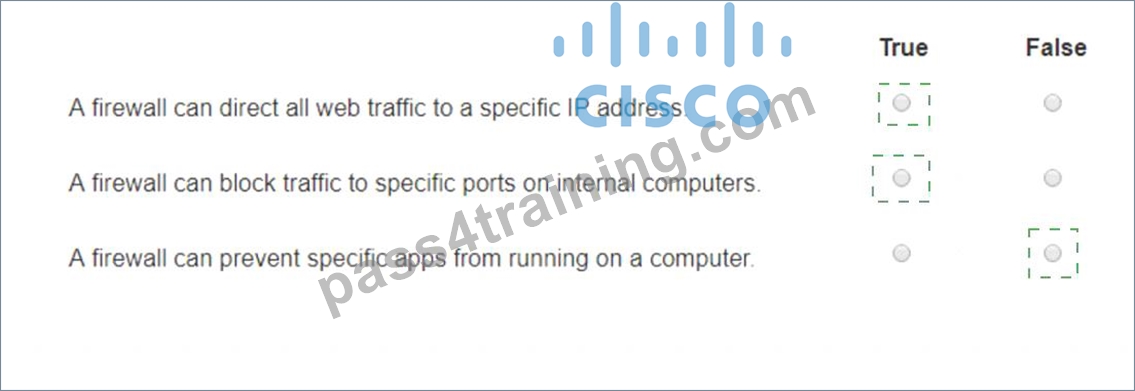
Explanation:
* A firewall can direct all web traffic to a specific IP address.
* True: Firewalls can be configured to perform Network Address Translation (NAT) and port forwarding, which can direct all web traffic (typically on port 80 and 443) to a specific internal IP address.
* A firewall can block traffic to specific ports on internal computers.
* True: Firewalls can be configured with access control lists (ACLs) or rules to block traffic to specific ports on internal computers, enhancing security by restricting unwanted or harmful traffic.
* A firewall can prevent specific apps from running on a computer.
* False: Firewalls typically control traffic flow and do not prevent specific applications from running on a computer. Application control is usually managed by endpoint security software or application control systems.
* Directing Web Traffic: Firewalls can manage traffic redirection using NAT and port forwarding rules to route web traffic to designated servers or devices within the network.
* Blocking Specific Ports: Firewalls can enforce security policies by blocking or allowing traffic based on port numbers, ensuring that only permitted traffic reaches internal systems.
* Application Control: While firewalls manage network traffic, preventing applications from running typically requires software specifically designed for endpoint protection and application management.
References:
* Understanding Firewalls: Firewall Capabilities
* Network Security Best Practices: Network Security Guide
NEW QUESTION # 22
Which command will display all the current operational settings configured on a Cisco router?
- A. show startup-config
- B. show version
- C. show running-config
- D. show protocols
Answer: C
Explanation:
Router
Theshow running-configcommand is used on a Cisco router to display the current operational settings that are actively configured in the router's RAM. This command outputs all the configurations that are currently being executed by the router, which includes interface configurations, routing protocols, access lists, and other settings. Unlikeshow startup-config, which shows the saved configuration that the router will use on the next reboot,show running-configreflects the live, current configuration in use.
References:= The information is supported by multiple sources that detail the use of Cisco commands, particularly theshow running-configcommand as the standard for viewing the active configuration on a Cisco device123.
* show running-config: This command displays the current configuration running on the router. It includes all the operational settings and configurations applied to the router.
* show protocols: This command shows the status of configured protocols on the router but not the entire configuration.
* show startup-config: This command displays the configuration saved in NVRAM, which is used to initialize the router on startup, but not necessarily the current running configuration.
* show version: This command provides information about the router's software version, hardware components, and uptime but does not display the running configuration.
References:
* Cisco IOS Commands: Cisco IOS Commands
NEW QUESTION # 23
Move each network type from the list on the left to the correct example on the right.
Answer:
Explanation:
Explanation:
* Two home office computers are connected to a switch by Ethernet cables.
* Network Type: LAN (Local Area Network)
* Explanation: A LAN connects devices within a limited area such as a home, office, or building, using Ethernet cables or Wi-Fi.
* Three government buildings in the same city connect to a cable company over coaxial cables.
* Network Type: MAN (Metropolitan Area Network)
* Explanation: A MAN connects networks across a city or campus, often using fiber optic or coaxial cables.
* A cell phone connects to a Bluetooth headset.
* Network Type: PAN (Personal Area Network)
* Explanation: A PAN connects devices within a personal workspace, typically using wireless technologies like Bluetooth.
* A financial institution connects its branches through a telecommunications service provider.
* Network Type: WAN (Wide Area Network)
* Explanation: A WAN connects multiple LANs over long distances, often using leased lines or satellite links provided by telecommunications companies.
* LAN (Local Area Network): Used for connecting devices within a small geographical area such as a
* single building or home.
* MAN (Metropolitan Area Network): Covers a larger geographical area than a LAN, typically a city or campus.
* PAN (Personal Area Network): Connects devices within the range of an individual person, such as connecting a phone to a Bluetooth headset.
* WAN (Wide Area Network): Spans large geographical areas, connecting multiple LANs across cities, countries, or continents.
References:
* Network Types Overview: Cisco Networking Basics
* Understanding Different Network Types: Network Types Guide
NEW QUESTION # 24
A help desk technician receives the four trouble tickets listed below. Which ticket should receive the highest priority and be addressed first?
- A. Ticket 2: An online webinar is taking place in the conference room. The video conferencing equipment lost internet access.
- B. Ticket 3: A user reports that response time for a cloud-based application is slower than usual.
- C. Ticket 4: Two users report that wireless access in the cafeteria has been down for the last hour.
- D. Ticket 1: A user requests relocation of a printer to a different network jack in the same office. The jack must be patched and made active.
Answer: A
Explanation:
When prioritizing trouble tickets, the most critical issues affecting business operations or high-impact activities should be addressed first. Here's a breakdown of the tickets:
* Ticket 1: Relocation of a printer, while necessary, is not urgent and does not impact critical operations.
* Ticket 2: An ongoing webinar losing internet access is critical, especially if the webinar is time-sensitive and involves multiple participants.
* Ticket 3: Slower response time for a cloud-based application is important but typically not as urgent as a complete loss of internet access for a live event.
* Ticket 4: Wireless access down in the cafeteria affects users but does not have the same immediate impact as a live webinar losing connectivity.
Thus, the correct answer is B. Ticket 2: An online webinar is taking place in the conference room. The video conferencing equipment lost internet access.
References:=
* IT Help Desk Best Practices
* Prioritizing IT Support Tickets
NEW QUESTION # 25
A help desk technician receives the four trouble tickets listed below. Which ticket should receive the highest priority and be addressed first?
- A. Ticket 2: An online webinar is taking place in the conference room. The video conferencing equipment lost internet access.
- B. Ticket 3: A user reports that response time for a cloud-based application is slower than usual.
- C. Ticket 4: Two users report that wireless access in the cafeteria has been down for the last hour.
- D. Ticket 1: A user requests relocation of a printer to a different network jack in the same office. The jack must be patched and made active.
Answer: A
NEW QUESTION # 26
What is the most compressed valid format of the IPv6 address 2001 :0db8:0000:0016:0000:001b: 2000:0056?
- A. 2001:db8: 16: :1b:2:56
- B. 2001:db8: : 16: : 1b:2:56
- C. 2001:db8: : 16: : 1b: 2000: 56
- D. 2001:db8: 0:16: :1b: 2000:56
Answer: D
Explanation:
IPv6 addresses can be compressed by removing leading zeros and replacing consecutive groups of zeros with a double colon (::). Here's how to compress the address 2001:0db8:0000:0016:0000:001b:2000:0056:
* Remove leading zeros from each segment:
* 2001:db8:0000:0016:0000:001b:2000:0056 becomes 2001:db8:0:16:0:1b:2000:56
* Replace the longest sequence of consecutive zeros with a double colon (::). In this case, the two consecutive zeros between the 16 and 1b:
* 2001:db8:0:16::1b:2000:56
Thus, the most compressed valid format of the IPv6 address is 2001:db8:0:16::1b:2000:56.
References:=
* Cisco Learning Network
* IPv6 Addressing (Cisco)
NEW QUESTION # 27
For each statement about bandwidth and throughput, select True or False.
Note: You will receive partial credit for each correct selection.
Answer:
Explanation:
Explanation:
* Statement 1: Low bandwidth can increase network latency.
* True: Low bandwidth can result in increased network latency because the network may become congested, leading to delays in data transmission.
* Statement 2: High levels of network latency decrease network bandwidth.
* False: High levels of network latency do not decrease the available network bandwidth, but they do affect the perceived performance and throughput of the network.
* Statement 3: You can increase throughput by decreasing network latency.
* True: Decreasing network latency can increase throughput because data can be transmitted more quickly and efficiently without delays.
* Bandwidth vs. Latency: Bandwidth refers to the maximum rate at which data can be transferred over a network path. Latency is the time it takes for a data packet to travel from the source to the destination.
* Low bandwidth can cause network congestion, which can increase latency as packets wait to be transmitted.
* High latency does not reduce the actual bandwidth but can affect the overall performance and efficiency of data transmission.
* Reducing latency can lead to higher throughput because the network can handle more data in a given period without delays.
References:
* Network Performance Metrics: Cisco Network Performance
* Understanding Bandwidth and Latency: Bandwidth vs. Latency
NEW QUESTION # 28
A Cisco switch is not accessible from the network. You need to view its running configuration.
Which out-of-band method can you use to access it?
- A. SNMP
- B. Telnet
- C. Console
- D. SSH
Answer: C
Explanation:
Out-of-band management
When a Cisco switch is not accessible from the network, the recommended out-of-band method to access its running configuration is through theconsole port. Out-of-band management involves accessing the network device through a dedicated management channel that is not part of the data network.The console port provides direct access to the switch's Command Line Interface (CLI) without using the network, which is essential when the switch cannot be accessed remotely via the network12.
References:=
* Out-of-band (OOB) network interface configuration guidelines
* Out of band management configuration
If you have any more questions or need further assistance, feel free to ask!
NEW QUESTION # 29
......
Dumps Real Cisco CCST-Networking Exam Questions [Updated 2024]: https://examsboost.pass4training.com/CCST-Networking-test-questions.html
