

Check Real Google Professional-Cloud-Architect Exam Question for Free (2026)
Get Ready to Boost your Prepare for your Professional-Cloud-Architect Exam with 378 Questions
Google Professional-Cloud-Architect certification exam is a computer-based test that consists of multiple-choice and multiple-select questions. Professional-Cloud-Architect exam duration is two hours, and the passing score is 70%. Professional-Cloud-Architect exam fee is $200, and the certification is valid for two years. Google recommends that candidates take the Architecting with Google Cloud Platform Specialization on Coursera before taking the exam.
NEW QUESTION # 106
Your customer support tool logs all email and chat conversations to Cloud Bigtable for retention and analysis. What is the recommended approach for sanitizing this data of personally identifiable information or payment card information before initial storage?
- A. Hash all data using SHA256
- B. Use regular expressions to find and redact phone numbers, email addresses, and credit card numbers
- C. Encrypt all data using elliptic curve cryptography
- D. De-identify the data with the Cloud Data Loss Prevention API
Answer: D
Explanation:
https://cloud.google.com/solutions/pci-dss-compliance-
ingcp#using_data_loss_prevention_api_to_sanitize_data
NEW QUESTION # 107
You need to migrate Hadoop jobs for your company's Data Science team without modifying the underlying infrastructure. You want to minimize costs and infrastructure management effort. What should you do?
- A. Create a Dataproc cluster using standard worker instances.
- B. Manually deploy a Hadoop cluster on Compute Engine using preemptible instances.
- C. Create a Dataproc cluster using preemptible worker instances.
- D. Manually deploy a Hadoop cluster on Compute Engine using standard instances.
Answer: C
Explanation:
https://cloud.google.com/architecture/hadoop/hadoop-gcp-migration-jobs
NEW QUESTION # 108
Your company has successfully migrated to the cloud and wants to analyze their data stream to optimize operations. They do not have any existing code for this analysis, so they are exploring all their options. These options include a mix of batch and stream processing, as they are running some hourly jobs and live-processing some data as it comes in. Which technology should they use for this?
- A. Google Compute Engine with Google BigQuery
- B. Google Container Engine with Bigtable
- C. Google Cloud Dataproc
- D. Google Cloud Dataflow
Answer: D
Explanation:
Cloud Dataflow is a fully-managed service for transforming and enriching data in stream (real time) and batch (historical) modes with equal reliability and expressiveness -- no more complex workarounds or compromises needed.
References: https://cloud.google.com/dataflow/
NEW QUESTION # 109
You are designing a mobile chat application. You want to ensure people cannot spoof chat messages, by providing a message were sent by a specific user.
What should you do?
- A. Use a trusted certificate authority to enable SSL connectivity between the client application and the server.
- B. Use public key infrastructure (PKI) to encrypt the message client side using the originating user's private key.
- C. Tag messages client side with the originating user identifier and the destination user.
- D. Encrypt the message client side using block-based encryption with a shared key.
Answer: A
Explanation:
Encrypting each block and tagging each message at the client side is an overhead on the application. Best method which has been adopted since years is contacting the SSL provider and use the public certificate to encrypt the traffic between client and the server.
NEW QUESTION # 110
Case Study: 6 - TerramEarth
Company Overview
TerramEarth manufactures heavy equipment for the mining and agricultural industries. About
80% of their business is from mining and 20% from agriculture. They currently have over 500 dealers and service centers in 100 countries. Their mission is to build products that make their customers more productive.
Solution Concept
There are 20 million TerramEarth vehicles in operation that collect 120 fields of data per second.
Data is stored locally on the vehicle and can be accessed for analysis when a vehicle is serviced.
The data is downloaded via a maintenance port. This same port can be used to adjust operational parameters, allowing the vehicles to be upgraded in the field with new computing modules.
Approximately 200,000 vehicles are connected to a cellular network, allowing TerramEarth to collect data directly. At a rate of 120 fields of data per second with 22 hours of operation per day, TerramEarth collects a total of about 9 TB/day from these connected vehicles.
Existing Technical Environment
TerramEarth's existing architecture is composed of Linux and Windows-based systems that reside in a single U.S. west coast based data center. These systems gzip CSV files from the field and upload via FTP, and place the data in their data warehouse. Because this process takes time, aggregated reports are based on data that is 3 weeks old.
With this data, TerramEarth has been able to preemptively stock replacement parts and reduce unplanned downtime of their vehicles by 60%. However, because the data is stale, some customers are without their vehicles for up to 4 weeks while they wait for replacement parts.
Business Requirements
Decrease unplanned vehicle downtime to less than 1 week.
Support the dealer network with more data on how their customers use their equipment to better
position new products and services
Have the ability to partner with different companies - especially with seed and fertilizer suppliers
in the fast-growing agricultural business - to create compelling joint offerings for their customers.
Technical Requirements
Expand beyond a single datacenter to decrease latency to the American Midwest and east
coast.
Create a backup strategy.
Increase security of data transfer from equipment to the datacenter.
Improve data in the data warehouse.
Use customer and equipment data to anticipate customer needs.
Application 1: Data ingest
A custom Python application reads uploaded datafiles from a single server, writes to the data warehouse.
Compute:
Windows Server 2008 R2
- 16 CPUs
- 128 GB of RAM
- 10 TB local HDD storage
Application 2: Reporting
An off the shelf application that business analysts use to run a daily report to see what equipment needs repair. Only 2 analysts of a team of 10 (5 west coast, 5 east coast) can connect to the reporting application at a time.
Compute:
Off the shelf application. License tied to number of physical CPUs
- Windows Server 2008 R2
- 16 CPUs
- 32 GB of RAM
- 500 GB HDD
Data warehouse:
A single PostgreSQL server
- RedHat Linux
- 64 CPUs
- 128 GB of RAM
- 4x 6TB HDD in RAID 0
Executive Statement
Our competitive advantage has always been in the manufacturing process, with our ability to build better vehicles for lower cost than our competitors. However, new products with different approaches are constantly being developed, and I'm concerned that we lack the skills to undergo the next wave of transformations in our industry. My goals are to build our skills while addressing immediate market needs through incremental innovations.
For this question, refer to the TerramEarth case study. To be compliant with European GDPR regulation, TerramEarth is required to delete data generated from its European customers after a period of 36 months when it contains personal data. In the new architecture, this data will be stored in both Cloud Storage and BigQuery. What should you do?
- A. Create a BigQuery table for the European data, and set the table retention period to 36 months.
For Cloud Storage, use gsutil to create a SetStorageClass to NONE action when with an Age condition of 36 months. - B. Create a BigQuery time-partitioned table for the European data, and set the partition expiration period to 36 months. For Cloud Storage, use gsutil to enable lifecycle management using a DELETE action with an Age condition of 36 months.
- C. Create a BigQuery time-partitioned table for the European data, and set the partition period to 36 months. For Cloud Storage, use gsutil to create a SetStorageClass to NONE action with an Age condition of 36 months.
- D. Create a BigQuery table for the European data, and set the table retention period to 36 months.
For Cloud Storage, use gsutil to enable lifecycle management using a DELETE action with an Age condition of 36 months.
Answer: B
NEW QUESTION # 111
You have an application deployed on Kubernetes Engine using a Deployment named echo-deployment. The deployment is exposed using a Service called echo-service. You need to perform an update to the application with minimal downtime to the application. What should you do?
- A. Update the deployment yaml file with the new container image. Use kubectl delete deployment/ echo-deployment and kubectl create -f <yaml-file>
- B. Use kubectl set image deployment/echo-deployment <new-image>
- C. Update the service yaml file which the new container image. Use kubectl delete service/echoservice and kubectl create -f <yaml-file>
- D. Use the rolling update functionality of the Instance Group behind the Kubernetes cluster
Answer: D
Explanation:
Reference: https://cloud.google.com/kubernetes-engine/docs/how-to/updating-apps
NEW QUESTION # 112
Your organization requires that metrics from all applications be retained for 5 years for future analysis in possible legal proceedings. Which approach should you use?
- A. Configure Stackdriver Monitoring for all Projects, and export to Google Cloud Storage.
- B. Configure Stackdriver Monitoring for all Projects, and export to BigQuery.
- C. Configure Stackdriver Monitoring for all Projects with the default retention policies.
- D. Grant the security team access to the logs in each Project.
Answer: A
Explanation:
For archival purposes, Customer should use Cloud Storage. BigQuery is a datawarehouse, and could eventually import data from Cloud Storage if necessary.
References:
https://cloud.google.com/monitoring/api/v3/metrics
https://cloud.google.com/stackdriver/
NEW QUESTION # 113
You want to enable your running Google Container Engine cluster to scale as demand for your application changes. What should you do?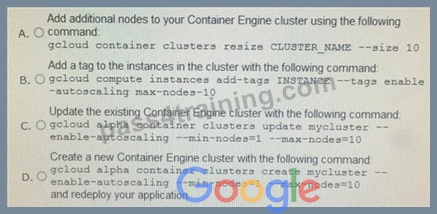
- A. Option C
- B. Option A
- C. Option D
- D. Option B
Answer: A
Explanation:
https://cloud.google.com/kubernetes-engine/docs/concepts/cluster-autoscaler To enable autoscaling for an existing node pool, run the following command:
gcloud container clusters update [CLUSTER_NAME] --enable-autoscaling \--min-nodes 1 -- max-nodes 10 --zone [COMPUTE_ZONE] --node-pool default-pool
NEW QUESTION # 114 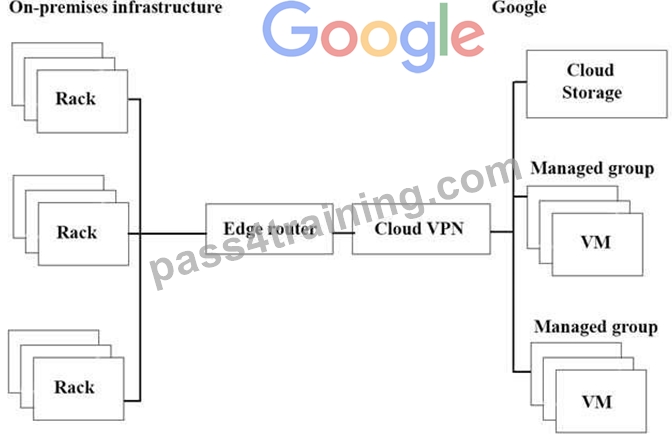
The migration of JencoMart's application to Google Cloud Platform (GCP) is progressing too slowly. The infrastructure is shown in the diagram. You want to maximize throughput.
What are three potential bottlenecks? (Choose three.)
- A. A single VPN tunnel, which limits throughput
- B. A tier of Google Cloud Storage that is not suited for this task
- C. A separate storage layer outside the VMs, which is not suited for this task
- D. A copy command that is not suited to operate over long distances
- E. Complicated internet connectivity between the on-premises infrastructure and GCP
- F. Fewer virtual machines (VMs) in GCP than on-premises machines
Answer: A,C,D
NEW QUESTION # 115
Your company wants you to build a highly reliable web application with a few public APIs as the backend. You don't expect a lot of user traffic, but traffic could spike occasionally. You want to leverage Cloud Load Balancing, and the solution must be cost-effective for users. What should you do?
- A. Store static content such as HTML and images in Cloud CDN.
Use Cloud Run to host the APIs and save the user data in Cloud SQL. - B. Store static content such as HTML and images in Cloud CDN.
Host the APIs on App Engine and store the user data in Cloud SQL. - C. Store static content such as HTML and images in a Cloud Storage bucket.
Host the APIs on a zonal Google Kubernetes Engine cluster with worker nodes in multiple zones, and save the user data in Cloud Spanner. - D. Store static content such as HTML and images in a Cloud Storage bucket.
Use Cloud Functions to host the APIs and save the user data in Firestore.
Answer: D
Explanation:
https://cloud.google.com/load-balancing/docs/https/setting-up-https-serverless#gcloud:-cloud- functions
https://cloud.google.com/blog/products/networking/better-load-balancing-for-app-engine-cloud- run-and-functions
NEW QUESTION # 116
You need to design a solution for global load balancing based on the URL path being requested. You need to ensure operations reliability and end-to-end in-transit encryption based on Google best practices.
What should you do?
- A. Create an HTTPS load balancer with URL maps.
- B. Create a global forwarding rule. Configure SSL proxy balancing.
- C. Create appropriate instance groups and instances. Configure SSL proxy load balancing.
- D. Create a cross-region load balancer with URL Maps.
Answer: A
Explanation:
Explanation
Reference https://cloud.google.com/load-balancing/docs/https/url-map
NEW QUESTION # 117
You have deployed an application to Kubernetes Engine, and are using the Cloud SQL proxy container to make the Cloud SQL database available to the services running on Kubernetes. You are notified that the application is reporting database connection issues. Your company policies require a post-mortem. What should you do?
- A. In the GCP Console, navigate to Stackdriver Logging. Consult logs for Kubernetes Engine and Cloud SQL.
- B. Validate that the Service Account used by the Cloud SQL proxy container still has the Cloud Build Editor role.
- C. Use gcloud sql instances restart.
- D. In the GCP Console, navigate to Cloud SQL. Restore the latest backup. Use kubectl to restart all pods.
Answer: B
NEW QUESTION # 118
Your development team has installed a new Linux kernel module on the batch servers in Google Compute Engine (GCE) virtual machines (VMs) to speed up the nightly batch process. Two days after the installation,
50% of web application deployed in the same
nightly batch run. You want to collect details on the failure to pass back to the development team. Which three actions should you take? Choose 3 answers
- A. Use gcloud or Cloud Console to connect to the serial console and observe the logs.
- B. Use Stackdriver Logging to search for the module log entries.
- C. Read the debug GCE Activity log using the API or Cloud Console.
- D. Adjust the Google Stackdriver timeline to match the failure time, and observe the batch server metrics.
- E. Export a debug VM into an image, and run the image on a local server where kernel log messages will be displayed on the native screen.
- F. Identify whether a live migration event of the failed server occurred, using in the activity log.
Answer: A,B,D
Explanation:
https://www.flexera.com/blog/cloud/2013/12/google-compute-engine-live-migration-passes-the-test/
"With live migration, the virtual machines are moved without any downtime or noticeable service degradation"
NEW QUESTION # 119
Your company has decided to build a backup replica of their on-premises user authentication PostgreSQL database on Google Cloud Platform. The database is 4 TB, and large updates are frequent. Replication requires private address space communication.
Which networking approach should you use?
- A. A Google Compute Engine instance with a VPN server installed connected to the data center network
- B. Google Cloud VPN connected to the data center network
- C. Google Cloud Dedicated Interconnect
- D. A NAT and TLS translation gateway installed on-premises
Answer: B
Explanation:
https://cloud.google.com/docs/enterprise/best-practices-for-enterprise-organizations
NEW QUESTION # 120
Case Study: 11 - TerramEarth
Company overview
TerramEarth manufactures heavy equipment for the mining and agricultural industries. They currently have over 500 dealers and service centers in 100 countries.
Their mission is to build products that make their customers more productive.
Solution concept
There are 2 million TerramEarth vehicles in operation currently, and we see 20% yearly growth.
Vehicles collect telemetry data from many sensors during operation. A small subset of critical data is transmitted from the vehicles in real time to facilitate fleet management. The rest of the sensor data is collected, compressed, and uploaded daily when the vehicles return to home base.
Each vehicle usually generates 200 to 500 megabytes of data per day.
Existing technical environment
TerramEarth's vehicle data aggregation and analysis infrastructure resides in Google Cloud and serves clients from all around the world. A growing amount of sensor data is captured from their two main manufacturing plants and sent to private data centers that contain their legacy inventory and logistics management systems. The private data centers have multiple network interconnects configured to Google Cloud. The web frontend for dealers and customers is running in Google Cloud and allows access to stock management and analytics.
Business requirements
- Predict and detect vehicle malfunction and rapidly ship parts to dealerships for just-in-time repair where possible.
- Decrease cloud operational costs and adapt to seasonality.
- Increase speed and reliability of development workflow.
- Allow remote developers to be productive without compromising code or data security.
- Create a flexible and scalable platform for developers to create custom API services for dealers and partners.
Technical requirements
- Create a new abstraction layer for HTTP API access to their legacy systems to enable a gradual move into the cloud without disrupting operations.
- Modernize all CI/CD pipelines to allow developers to deploy container-based workloads in highly scalable environments.
- Allow developers to run experiments without compromising security and governance requirements.
- Create a self-service portal for internal and partner developers to create new projects, request resources for data analytics jobs, and centrally manage access to the API endpoints.
- Use cloud-native solutions for keys and secrets management and optimize for identity-based access.
- Improve and standardize tools necessary for application and network monitoring and troubleshooting.
Executive statement
Our competitive advantage has always been our focus on the customer, with our ability to provide excellent customer service and minimize vehicle downtimes.
After moving multiple systems into Google Cloud, we are seeking new ways to provide best-in- class online fleet management services to our customers and improve operations of our dealerships. Our 5-year strategic plan is to create a partner ecosystem of new products by enabling access to our data, increasing autonomous operation capabilities of our vehicles, and creating a path to move the remaining legacy systems to the cloud.
For this question, refer to the TerramEarth case study. You are building a microservice-based application for TerramEarth. The application is based on Docker containers. You want to follow Google-recommended practices to build the application continuously and store the build artifacts.
What should you do?
- A. Configure a trigger in Cloud Build for new source changes. The trigger invokes build jobs and build container images for the microservices. Tag the images with a version number, and push them to Cloud Storage.
- B. Create a Scheduler job to check the repo every minute. For any new change, invoke Cloud Build to build container images for the microservices. Tag the images using the current timestamp, and push them to the Container Registry.
- C. Configure a trigger in Cloud Build for new source changes. Invoke Cloud Build to build one container image, and tag the image with the label 'latest.' Push the image to the Container Registry.
- D. Configure a trigger in Cloud Build for new source changes. Invoke Cloud Build to build container images for each microservice, and tag them using the code commit hash. Push the images to the Container Registry.
Answer: D
NEW QUESTION # 121
You are using Cloud SQL as the database backend for a large CRM deployment. You want to scale as usage increases and ensure that you don't run out of storage, maintain 75% CPU usage cores, and keep replication lag below 60 seconds. What are the correct steps to meet your requirements?
- A. 1. Create a Stackdriver alert when storage exceeds 75%, and increase the available storage on the instance to create more space.
2. Deploy memcached to reduce CPU load.
3. Change the instance type to a 32-core machine type to reduce replication lag. - B. 1. Create a Stackdriver alert when storage exceeds 75%, and increase the available storage on the instance to create more space.
2. Deploy memcached to reduce CPU load.
3. Create a Stackdriver alert for replication lag, and change the instance type to a 32-core machine type to reduce replication lag. - C. 1. Enable automatic storage increase for the instance.
2. Create a Stackdriver alert when CPU usage exceeds 75%, and change the instance type to reduce CPU usage.
3. Create a Stackdriver alert for replication lag, and shard the database to reduce replication time. - D. 1. Enable automatic storage increase for the instance.
2. Change the instance type to a 32-core machine type to keep CPU usage below 75%.
3. Create a Stackdriver alert for replication lag, and deploy memcache to reduce load on the master.
Answer: C
NEW QUESTION # 122
Your customer support tool logs all email and chat conversations to Cloud Bigtable for retention and analysis.
What is the recommended approach for sanitizing this data of personally identifiable information or payment card information before initial storage?
- A. Use regular expressions to find and redact phone numbers, email addresses, and credit card numbers
- B. De-identify the data with the Cloud Data Loss Prevention API
- C. Encrypt all data using elliptic curve cryptography
- D. Hash all data using SHA256
Answer: D
NEW QUESTION # 123
You have an App Engine application that needs to be updated. You want to test the update with production traffic before replacing the current application version.
What should you do?
- A. Deploy the update in a new VPC, and use Google's global HTTP load balancing to split traffic between the update and current applications.
- B. Deploy the update using the Instance Group Updater to create a partial rollout, which allows for canary testing.
- C. Deploy the update as a new App Engine application, and use Google's global HTTP load balancing to split traffic between the new and current applications.
- D. Deploy the update as a new version in the App Engine application, and split traffic between the new and current versions.
Answer: C
Explanation:
Explanation/Reference:
NEW QUESTION # 124
......
Use Free Professional-Cloud-Architect Exam Questions that Stimulates Actual EXAM : https://examsboost.pass4training.com/Professional-Cloud-Architect-test-questions.html
